On this page (11)
- What Is AI for Call Routing
- The Old Way Versus the AI Way
- Why Routing Accuracy Matters More Than Routing Speed
- How AI Call Routing Actually Works
- What Good AI Call Routing Should Include
- How This Fits Into a Full Call Handling System
- Where Businesses See the Biggest Impact
- Evaluating an AI Call Routing System, Questions Worth Asking
- A Simple Way to Estimate the Value of Better Routing
- Common Questions
- Getting Call Routing Right
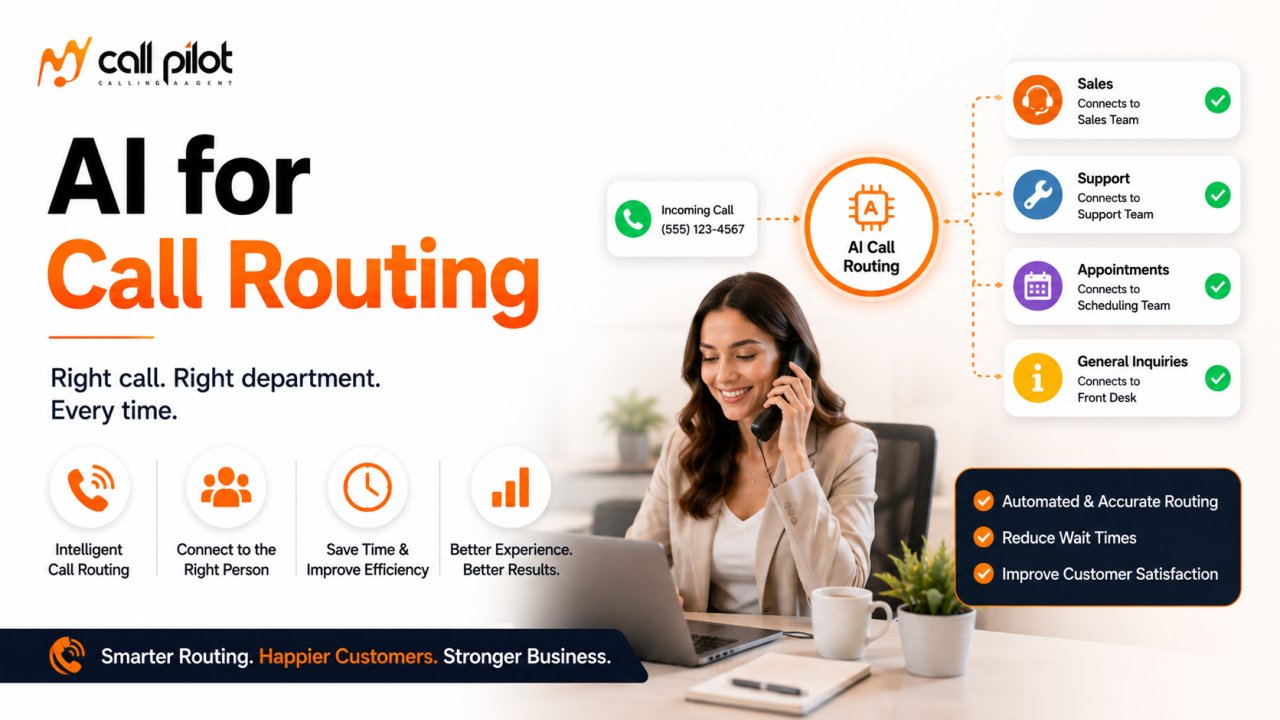
AI for call routing listens to what a caller actually needs and sends the call to the right person, team, or automated answer immediately, instead of making the caller work through a rigid phone menu to get there.
Most businesses still route calls the old way. A caller presses a number, waits, maybe gets transferred once or twice and repeats their situation to each new person before anyone actually helps them. Every one of those extra steps is a chance for the caller to give up. AI call routing removes the guesswork by understanding what the caller is asking for in plain language and sending them straight to the right outcome the first time.
What Is AI for Call Routing
AI for call routing is technology that uses natural language understanding and often real time data such as caller history or account status, to figure out why someone is calling and automatically direct that call to the best destination, whether that is a specific person, a department, a booking flow, or a direct answer, without relying on a fixed keypad menu.
This is meaningfully different from the routing most businesses already have. Traditional call routing, technically called automatic call distribution or ACD, simply sends a call to the next available person in a list, or to whichever option a caller selected on a menu. It has no understanding of what the caller actually needs. AI call routing adds that missing layer of understanding on top.
The Old Way Versus the AI Way
| Traditional IVR and ACD | AI Call Routing | |
|---|---|---|
| How it decides | Fixed menu choice or next available agent | Understands the caller's actual request |
| Handles an unclear request | Sends caller to a generic queue or wrong option | Can ask a clarifying question, then route correctly |
| Uses account or history data | Rarely, without added integration | Often, when connected to a CRM or customer record |
| What the caller experiences | Press this number for that option | A short conversation that ends at the right place |
| Common failure mode | Wrong department, repeated transfers | Misread intent, though far less common with a well trained system |
Why Routing Accuracy Matters More Than Routing Speed
This is the point most guides on this topic skip past and it matters enough to say directly. A system that routes a caller instantly to the wrong person has not actually solved anything. It has just moved the delay to a second call or a second transfer and added a frustrated caller who now has to explain their situation twice.
Industry data backs this up. Research cited across multiple call routing platforms shows that correctly routed calls can cut response times by more than 60% and lift customer satisfaction by roughly 25%, because the caller reaches someone who can actually help without needing to be re explained. The gain does not come from speed alone, it comes from the caller landing in the right place the first time.
Poor routing has a specific, well documented failure mode too. When a system sends a caller to a self service option that cannot actually resolve their issue, the caller ends up right back in the queue, often more frustrated than before. Fast but inaccurate routing can be worse for a business than a short, honest wait, since it wastes the caller's time twice instead of once.
How AI Call Routing Actually Works
A call comes in. The AI listens to what the caller says in their own words, rather than waiting for a keypad selection. It identifies the intent behind the request, checks any available context such as account information, prior call history, or the reason listed for a scheduled callback and decides the best destination for that specific call. That destination might be a specific team member, a department, an automated booking flow, or a direct answer to a simple question. If the request is complex or outside what the system is configured to handle, it hands the caller to a human with full context already attached, so the person does not have to start the conversation over.
Some systems also weigh urgency and tone. A caller who sounds distressed or describes an urgent problem can be prioritized ahead of a routine question, the same way an experienced front desk person would triage calls naturally.
What Good AI Call Routing Should Include
- Understanding a caller's request in natural language, not just a menu selection
- Routing based on real context, such as who is calling and why, not just which button they pressed
- A clear escalation path to a human whenever the request is outside its configured scope
- Passing full context to whoever the call is routed to, so the caller never has to repeat themselves
- Handling urgency appropriately, rather than treating every call as equally routine
- Working the same way across inbound calls, outbound follow up and website inquiries, rather than requiring separate tools for each
How This Fits Into a Full Call Handling System
Routing on its own only decides where a call goes. The systems built around routing decide what happens once it gets there. My Call Pilot's platform combines routing, answering and conversation in one conversational AI layer, covering inbound answering, outbound calling and website voice and chat widgets, with usage managed as minutes on a single plan. That means the same understanding of a caller's intent that decides where to route a call can also be the thing that actually answers the call, books an appointment, or captures a lead, rather than routing being a separate tool bolted onto everything else.
Specific routing configuration options, such as custom rules by department, skill, or time of day, vary by setup, so confirm exactly what can be customized for your business directly with the team rather than assuming every option applies automatically.
Where Businesses See the Biggest Impact
- Businesses with more than one department or location, where the wrong destination means a wasted transfer
- Businesses with uneven call volume, where some callers need a human immediately and others just need a quick answer
- Businesses that currently rely on a receptionist or office manager to manually redirect most incoming calls
- Businesses losing calls after hours or during peak periods, where no one is available to route the call manually at all
- Businesses running both inbound support and outbound follow up, where consistent routing logic across both saves real staff time
Evaluating an AI Call Routing System, Questions Worth Asking
- Does it understand open ended requests, or does it still rely on a menu underneath the AI layer
- What happens when it is not confident about where a call should go, does it guess, ask a clarifying question, or escalate to a human
- Can it use real account or customer data to route more accurately, or does every caller get treated the same
- Does it pass full context to whoever receives the call, so the caller does not repeat themselves
- Can it prioritize urgent calls ahead of routine ones
- Does the same routing logic apply across inbound calls, outbound calls and website inquiries, or is each channel a separate system
- How is accuracy actually measured, is it just speed to answer, or does the vendor track whether calls landed in the right place the first time
A Simple Way to Estimate the Value of Better Routing
Rather than relying on a generic industry percentage, a straightforward way to estimate your own opportunity.
Calls handled per month, multiplied by the share that are currently misrouted or transferred more than once, multiplied by the average staff time spent correcting a misroute, multiplied by a reasonable hourly labor cost, gives a rough monthly cost of poor routing alone, before counting the callers who simply give up rather than wait through a second transfer.
For example, a business handling 800 calls a month, with 15% requiring a correction or extra transfer, at 4 minutes of staff time per correction and a $25 hourly labor cost, is spending roughly 800 times 0.15 times 4 minutes times the relevant per minute labor cost, which comes out to around $200 a month in staff time on routing corrections alone, not counting any lost business from frustrated callers. Run this with your own call volume and correction rate rather than a general estimate, since it varies significantly by business size and call complexity.
Common Questions
How is AI call routing different from a regular phone menu?
A regular menu only understands a keypad selection. AI call routing understands what the caller actually says, so it can handle requests the menu designer never anticipated.
Does AI call routing replace a receptionist?
For most businesses it replaces the manual work of redirecting calls, not the judgment a person applies to unusual situations. Most setups still escalate complex or sensitive calls to a human.
Can it route based on account or customer history?
When connected to a CRM or customer record, yes, in most configurations. Without that connection, it can still route based on what the caller says, just without the added context.
What happens if it misunderstands a caller?
A well built system asks a clarifying question or escalates to a human rather than guessing and sending the caller somewhere wrong. Confirm this behavior specifically with any vendor before relying on it.
Does it work for outbound calls too, not just inbound?
Depending on the platform, the same intent understanding used for inbound routing can also apply to outbound calls, such as directing a callback to the right follow up path.
Is AI call routing only useful for large call centers?
No. Smaller businesses often see a proportionally larger benefit, since a missed or misrouted call at a small business is a larger share of that day's total opportunities than it would be at a large call center with hundreds of agents.
Getting Call Routing Right
If callers at your business regularly get sent to the wrong person, sit through a menu that does not match how they would actually describe their problem, or get transferred more than once before reaching someone useful, the underlying issue is usually the routing logic, not the people answering the phone.
My Call Pilot brings intent based routing together with inbound answering, outbound calling and website voice and chat widgets on one platform, so a caller's request is understood once and handled correctly from there, no matter which channel they used to reach you.