On this page (36)
- What Is an AI Receptionist for Small Business
- Why Small Businesses Are Turning to AI Receptionists
- AI Receptionist vs Voicemail
- How Does an AI Receptionist Work
- What Can an AI Receptionist Do for a Small Business
- AI Receptionist for Small Business: Who Is It For
- AI Receptionist vs Traditional Receptionist
- AI Receptionist vs Virtual Receptionist
- AI Answering Service vs AI Receptionist
- What Is a Conversational AI Receptionist
- AI for Customer Support
- Automated Phone System vs AI Receptionist
- How Much Does an AI Receptionist Cost for a Small Business
- How to Calculate Whether an AI Receptionist Is Worth It
- What Makes an AI Receptionist Good for Small Business
- What Happens When AI Does Not Know the Answer
- Can an AI Receptionist Replace a Human Receptionist
- Why an AI Receptionist Can Be Especially Useful for Solo Business Owners
- AI Receptionist for Growing Small Businesses
- AI Receptionist for Local Service Businesses
- AI Receptionist for Businesses That Receive Calls While Employees Are Busy
- AI Receptionist for After-Hours Customer Calls
- How to Set Up an AI Receptionist Strategy
- Common Mistakes Businesses Make With AI Receptionists
- How My Call Pilot Fits Into the AI Receptionist Conversation
- Why Choose an AI Voice Agent Platform Instead of a Basic Phone Menu
- What Small Business Owners Should Ask Before Choosing an AI Receptionist
- Is an AI Receptionist Worth It for a Small Business
- AI Receptionist ROI: Look Beyond the Monthly Subscription
- AI Receptionist and Customer Experience
- The Future of Small Business Phone Answering
- Frequently Asked Questions About AI Receptionists for Small Business
- AI Receptionist for Different Small Business Scenarios
- Build a Better Phone Experience With My Call Pilot
- Start With Your Business's Real Calls
- Final Takeaway
Running a small business often means doing several jobs at once.
You may be serving a customer, meeting with a client, working at a job site, managing your team, preparing an estimate or simply trying to finish the workday when another phone call comes in.
And every call matters.
A potential customer may be calling to ask about your services. Someone may want to schedule an appointment. An existing customer may have a question. A new lead may be ready to buy but unwilling to leave a voicemail and wait for a callback.
That is where an AI receptionist for small business can help.
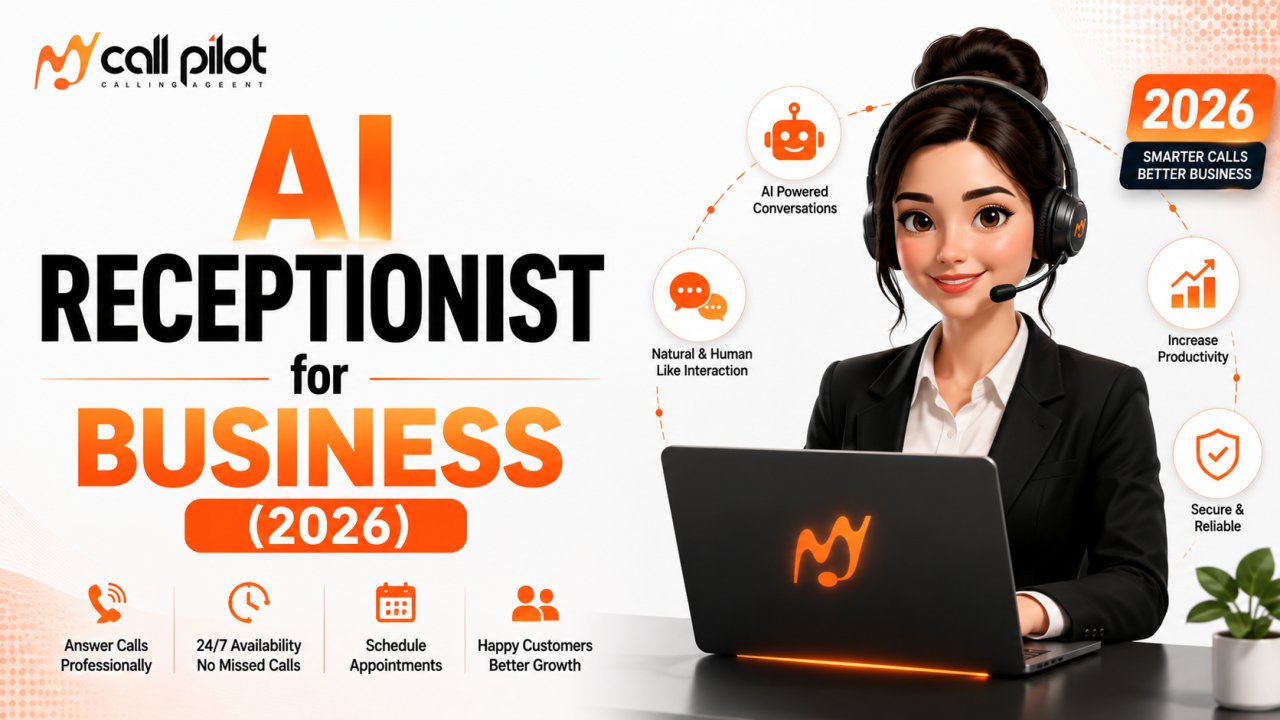
My Call Pilot is positioned as an AI Voice Agent Platform designed around business phone conversations, giving businesses a way to explore AI-powered call handling instead of relying entirely on voicemail, manual answering or traditional phone systems.
The goal is simple: make it easier for businesses to handle incoming conversations while allowing owners and employees to focus on the work that actually requires their attention.
What Is an AI Receptionist for Small Business
An AI receptionist is an AI-powered phone assistant that can interact with callers using natural-language conversation rather than requiring callers to navigate a rigid phone menu.
Instead of a customer hearing "press 1 for sales, press 2 for support, press 3 for hours, press 4 to repeat this menu," an AI receptionist can be designed around conversational interactions.
A caller can explain what they need, and the AI receptionist can respond according to the information, instructions and call-handling rules provided to the business.
For a small business, this can create a more flexible approach to handling routine phone conversations. Depending on the specific system and configuration, AI receptionist solutions can be used for activities such as
- Answering incoming business calls
- Providing frequently requested business information
- Handling common customer questions
- Collecting caller information
- Identifying the purpose of a call
- Qualifying potential leads
- Helping with appointment-related conversations
- Routing or escalating calls when appropriate
- Supporting after-hours call handling
- Acting as an automated first point of contact
- Reducing dependence on voicemail for routine calls
The exact capabilities available depend on the AI receptionist platform and how the business configures it.
For small businesses, the important question is not simply whether AI can answer a phone. The better question is: can an AI receptionist handle the types of conversations my customers actually have? That is the question business owners should use when evaluating an AI receptionist.
Why Small Businesses Are Turning to AI Receptionists
Small businesses often have a very specific phone problem. They need to answer calls, but they do not necessarily need another full-time employee sitting beside the phone all day.
A local contractor may spend most of the day on job sites. A dentist or healthcare office may have staff helping patients. A real estate professional may be showing properties. A lawyer may be in a consultation. A salon employee may be serving a customer. An automotive business may have technicians working on vehicles. A property manager may be handling an urgent issue.
In each situation, the phone can continue ringing even when nobody is available to answer it. That creates a gap between customer demand and staff availability. An AI receptionist can potentially help businesses fill that gap with automated phone conversations.
The problem is bigger than missed calls
A missed call is not simply a missed phone event. It can represent a new lead, a potential appointment, a service inquiry, a pricing question, an existing customer needing assistance, an urgent request, a repeat customer, a referral or a customer comparing several businesses.
The person calling may not know that the business owner is busy. They simply know that they called. If the experience becomes voicemail, silence, repeated transfers or an unclear automated menu, the caller may move on to another business.
That is why an AI receptionist for small business is increasingly being considered as a practical customer communication tool rather than merely an experimental AI technology.
AI Receptionist vs Voicemail
Voicemail is useful, but it puts the next step entirely on the customer and the business. The customer has to leave a message. The business has to retrieve it. Someone has to understand the request. Someone has to call back. And the customer has to answer when the callback arrives.
An AI receptionist can provide a conversational first layer instead. Instead of simply saying "please leave your name, number and message after the tone," a conversational AI system can potentially gather more context from the caller.
For example, a caller might say "I need to schedule an estimate for a roof repair." A conversational system can be designed to understand that the caller is interested in a service, gather relevant information and follow the business's configured call flow.
The result is a fundamentally different customer experience. Voicemail records a message. Conversational AI can interact with the caller. That distinction is one of the biggest reasons businesses investigate AI receptionist solutions.
How Does an AI Receptionist Work
An AI receptionist generally combines several technologies into one phone conversation. At a high level, the process looks like this: caller reaches the business phone, the AI voice agent understands the request, responds and takes the next appropriate action.
The exact implementation differs between platforms, but the underlying concept is straightforward.
A customer calls the business
The process begins when someone contacts the business by phone. The caller does not need to understand the technology behind the system. From their perspective, they are simply calling a business.
The AI voice agent handles the conversation
The AI voice agent processes what the caller says and determines how the conversation should proceed according to the business's configuration. This is where conversational AI differs from a traditional automated phone tree. The interaction can be designed around natural-language conversation rather than only fixed button selections.
The AI identifies the caller's intent
A caller might be asking "are you open today," "do you provide this service," "I want to schedule an appointment," "I need someone to call me back," "I have a question about my existing service" or "can someone help me with an estimate." An AI receptionist can be configured to recognize different types of requests and follow appropriate workflows.
The AI responds using business information
A useful AI receptionist needs accurate business information. That can include business hours, services, policies, frequently asked questions, contact information, service areas, call-handling instructions and escalation rules. The quality of the customer experience depends heavily on how well the system is configured and how accurately the underlying business information is maintained.
The conversation moves toward the appropriate outcome
The objective should not be to keep callers talking to AI indefinitely. The objective is to move the caller toward the correct next step. Depending on the business and system configuration, that might mean providing an answer, capturing information, helping with an appointment workflow, routing a call, escalating to a human or recording a request for follow-up.
This is an important principle when evaluating an AI receptionist: good automation is not about replacing every human interaction, it is about making sure the right calls reach the right outcome.
What Can an AI Receptionist Do for a Small Business
The answer depends on the platform and configuration, but there are several common use cases worth considering.
1. Answer common customer questions
Many business calls are repetitive. Customers may repeatedly ask about business hours, services, locations, availability, general policies, service areas or basic business information. If these questions can be answered using accurate business information, an AI receptionist can potentially reduce the amount of routine work handled manually by staff. That allows employees to spend less time repeating the same basic information.
2. Capture new leads
Phone calls can represent high-intent prospects. Someone who picks up the phone and calls a business is often further along than someone who casually browses a website. An AI receptionist can be used as the first conversation with that prospect.
The objective is to understand why they called and collect the information needed for the next step. For example, a service business may need to know the customer name, contact information, requested service, general location, nature of the request and preferred appointment timing. The exact information should depend on the business. The important principle is to avoid treating every caller as simply "another phone number." The conversation should capture useful context.
3. Handle after-hours calls
Customers do not always call during convenient office hours. A prospect might search for a business after work and call immediately. A homeowner might need information in the evening. A customer might remember an issue on a weekend.
A business that sends every after-hours call directly to voicemail creates a gap between when customers want to communicate and when employees are available. An AI answering service can potentially provide an automated first point of contact during those periods. This makes after-hours call handling one of the strongest use cases for small businesses evaluating AI receptionist technology.
4. Support busy employees
An AI receptionist does not necessarily need to replace an employee. It can instead support employees.
Consider a small business with one person handling the front desk. When that employee is already speaking with a customer, another call creates a conflict. With automated phone handling, the business can create an additional layer between incoming demand and staff availability. The human employee can focus on the customer directly in front of them while the automated system handles appropriate routine interactions. This is especially relevant for businesses where phone calls compete with hands-on work.
5. Route important calls
Not every call should receive the same treatment. A routine question may not require a human. A high-priority issue may.
An AI receptionist can be configured around rules that determine which types of conversations should be handled automatically and which should move toward a human team member. The exact routing functionality depends on the platform and configuration. The strategic concept, however, is powerful: automate routine conversations and escalate conversations that need human judgment.
6. Improve customer access
Small businesses compete with larger organizations that often have dedicated customer-service departments. A small company may not have the same staffing resources.
An AI receptionist can help a small business think differently about customer access. Instead of asking "how many people can I afford to put on the phones," the business can ask "which conversations require a person, and which conversations can technology handle." That shift can make phone operations more scalable.
AI Receptionist for Small Business: Who Is It For
An AI receptionist can be relevant to many types of small businesses, particularly companies where phone calls directly influence leads, appointments, bookings, service requests or customer support.
Home service businesses
Home service businesses often operate away from a traditional office. Examples include HVAC companies, plumbing companies, roofing contractors, electrical contractors, landscaping businesses, cleaning companies, pest control companies, remodeling businesses and handyman services. A technician may be physically unable to answer a call while working, which makes phone automation particularly relevant. An AI receptionist can serve as the first point of contact while the team focuses on completing the work.
Dental practices
Dental offices receive many repetitive phone inquiries. Patients may call about appointments, office hours, services, general questions, existing appointments or new-patient information. An AI receptionist can potentially help organize these conversations and reduce pressure on front-desk staff. For healthcare-related businesses, however, configuration, privacy, compliance, escalation and data-handling requirements should always be evaluated carefully before deployment.
Real estate businesses
Real estate professionals often work outside a traditional desk environment. They may be showing properties, meeting buyers, meeting sellers, driving between appointments, negotiating transactions or speaking with clients. Phone availability can therefore become inconsistent. An AI receptionist can potentially provide an initial conversational layer for incoming inquiries while the agent is occupied.
Law firms
Law firms receive calls from prospective clients, existing clients, referral sources and other parties. Some inquiries are routine. Others require professional judgment. That makes call qualification and appropriate escalation particularly important. An AI receptionist can potentially support the front-end communication process, while sensitive or substantive legal matters remain with qualified human professionals.
Automotive businesses
Auto repair shops, dealerships, body shops, tire businesses and related companies depend heavily on phone communication. Customers may call about service availability, repair questions, vehicle issues, appointments, estimates, business hours or pickup and drop-off questions. A conversational phone system can potentially handle appropriate routine inquiries while staff remain focused on customers and vehicles.
Property management
Property managers often receive different types of calls from tenants, owners, prospective renters, vendors and maintenance contacts. Some requests are routine. Others may require immediate attention. A properly configured AI receptionist can potentially help separate routine requests from calls that need human intervention.
Professional services
Small professional-service businesses can also benefit from better phone handling. Examples include accounting firms, consulting businesses, marketing agencies, insurance agencies, financial service businesses and B2B service companies. The opportunity is not necessarily about answering every call with AI. It is about creating a more organized first point of contact.
AI Receptionist vs Traditional Receptionist
The comparison is not simply AI versus human. They solve different operational problems. A traditional receptionist provides human judgment, empathy, context and flexibility. An AI receptionist provides automated conversational handling that can operate according to defined instructions.
| Factor | AI Receptionist | Human Receptionist |
|---|---|---|
| Routine questions | Strong fit | Strong fit |
| Human judgment | Limited | Strong |
| Natural conversation | Increasingly capable | Strong |
| Repetitive inquiries | Good automation opportunity | Can become repetitive |
| Availability | Depends on service | Based on staffing |
| Scalability | Can support automated volume | Requires additional staff |
| Complex situations | Usually requires escalation | Strong |
| Personal relationship | Limited compared with humans | Strong |
| Consistent scripted information | Strong | Depends on employee |
| Cost structure | Platform-dependent | Employee-based |
The right decision depends on the business. For many small businesses, the strongest approach may not be to eliminate human reception. It may be to use automation for the conversations that do not require a human while keeping people involved where human judgment matters.
AI Receptionist vs Virtual Receptionist
These terms are often used interchangeably, but they can describe different services. A virtual receptionist traditionally refers to a remote human or outsourced receptionist service that handles calls on behalf of a business. An AI receptionist uses artificial intelligence and automated voice conversation to handle calls.
The biggest distinction is who is performing the conversation.
Virtual receptionist usually involves human staff working remotely. Potential advantages include human interaction, flexible judgment, personal communication and the ability to handle unusual conversations. Potential considerations include staffing costs, availability, call volume limitations, service-level differences and pricing structures.
AI receptionist uses AI-powered voice technology. Potential advantages include automation, consistency, scalability and the ability to handle routine conversations without a human answering every call. Potential considerations include configuration quality, accuracy of business information, conversation quality, appropriate escalation and platform limitations.
For businesses comparing the two, the key question is: which calls do you want automated, and which calls should always involve a person? That question is more useful than simply asking which technology is better.
AI Answering Service vs AI Receptionist
An AI answering service and an AI receptionist can overlap significantly. However, the positioning can differ.
An AI answering service may focus primarily on ensuring calls are answered and information is captured. An AI receptionist generally implies a broader front-desk role. That can include conversational handling, qualification, routing, scheduling-related workflows and other customer-facing tasks depending on the system.
Think about the difference this way. An AI answering service says "someone called, let's make sure the call is handled." An AI receptionist says "someone called, let's understand why they called and guide the conversation toward the appropriate next step."
Neither model is automatically better. The right choice depends on the complexity of your calls.
What Is a Conversational AI Receptionist
A conversational AI receptionist uses natural-language interaction instead of relying entirely on rigid menu structures. Traditional automated phone systems often require callers to follow predetermined choices. Conversational AI is designed to interpret what the caller says.
For example, a caller might say "I need to schedule a service appointment, but I'm only available Friday afternoon." Instead of forcing the caller to select several menu options, a conversational system can be designed to recognize the request and continue the interaction based on the configured workflow.
The goal is not simply automation. The goal is useful automation through conversation.
AI for Customer Support
Customer support is another area where AI can assist small businesses. A business may receive the same support questions repeatedly. If customers can get clear answers to routine questions without waiting for an employee, the overall support process can become more efficient.
AI for customer support can potentially help with frequently asked questions, basic information requests, first-line communication, customer intake, routing, message collection and general support workflows.
However, businesses should establish clear boundaries. AI should not be expected to make decisions that require professional judgment unless the system has been specifically designed and validated for that use case.
A good customer-support strategy identifies what AI can answer, what AI can collect, what AI can route and what must go to a human. That framework is more valuable than simply trying to automate everything.
Automated Phone System vs AI Receptionist
An automated phone system is a broad category. Traditional systems can include IVR menus, call routing, voicemail, recorded messages, extensions and business-hour rules.
An AI receptionist adds a conversational layer. Instead of requiring customers to fit their needs into a predefined menu, an AI voice agent can be designed to interpret conversational requests. This can make the experience more natural for callers.
However, traditional phone systems still have value. For simple routing requirements, a conventional automated phone system may be enough. For businesses receiving more conversational inquiries, an AI receptionist may provide a more flexible approach.
How Much Does an AI Receptionist Cost for a Small Business
There is no single universal price for an AI receptionist. Pricing varies based on factors such as number of calls, minutes used, number of phone numbers, features, voice technology, call routing requirements, appointment workflows, integrations, support level, customization and business complexity.
Current competitors show a wide range of pricing models. Some small-business AI receptionist services advertise entry-level pricing around tens of dollars per month, while more feature-rich services can cost hundreds of dollars monthly.
This is why businesses should not choose a platform solely by looking for the cheapest monthly subscription. Instead, calculate the value of the calls being handled: monthly AI receptionist cost versus the potential value of calls, leads, appointments and customer interactions handled.
A low-cost system that cannot handle your actual call scenarios may be more expensive in practice than a higher-value solution that fits your business.
What should you ask about virtual receptionist pricing
When comparing virtual receptionist pricing or AI receptionist pricing, ask whether pricing is based on calls or minutes, whether there are setup fees, whether there are usage limits, what happens when the limit is exceeded, whether phone numbers are included, whether call routing is included, whether advanced workflows are included, whether integrations are included, whether support is included, whether the system can scale with the business and whether there are contract requirements. Do not compare monthly prices without comparing what each service actually provides.
How to Calculate Whether an AI Receptionist Is Worth It
You do not need complicated financial modeling. Start with your current phone activity.
Step 1: Estimate monthly inbound calls. How many calls does your business receive?
Step 2: Estimate missed or unanswered calls. How many calls happen when employees are unavailable?
Step 3: Identify high-value calls. Which calls can create revenue? For example, new customer inquiries, booking requests, service estimates, consultations or product inquiries.
Step 4: Estimate the value of a customer. If one new customer is worth $500, $1,000, $5,000 or more over time, a small improvement in call handling can matter.
Step 5: Compare the cost. Now compare the estimated value of better call handling against the cost of the AI receptionist solution.
This is more useful than asking "is AI receptionist software cheap?" The better question is: does improving the way my business handles calls justify the investment?
What Makes an AI Receptionist Good for Small Business
Not every AI receptionist is equally suitable for every business. Before choosing a solution, evaluate it against real conversations.
Can it understand your customers
Your customers may use industry terminology, local terminology, different accents, informal language, incomplete explanations or complex questions. Test real scenarios.
Can you control what it says
Businesses need confidence that the AI does not improvise important information. Ask how business information and conversation instructions are configured.
Can it handle exceptions
A perfect system does not exist. The important question is what happens when the AI does not know the answer. Does it ask for clarification, take a message, route the caller, escalate or end the call? A defined fallback process is essential.
Can it work with your existing workflow
Consider how the AI receptionist fits into your business rather than evaluating it in isolation.
Is the conversation natural
Customers do not want to fight with technology. Test actual calls. Listen for response speed, understanding, interruptions, repetition, confusing answers, awkward transitions and incorrect assumptions.
Can you measure what happens
Businesses should ideally be able to understand how their phone interactions are performing. The specific analytics available depend on the platform.
What Happens When AI Does Not Know the Answer
This is one of the most important questions a business owner should ask. The answer should never be "the AI will just figure it out." That is not a reliable business strategy.
Instead, businesses should define what happens when a question is outside the AI's knowledge. A sensible call-handling strategy may involve recognizing that the request is outside scope, avoiding an unsupported answer, collecting relevant information, routing or escalating when appropriate and creating a clear next step for the customer.
This is especially important for industries where incorrect information can create financial, legal, medical or operational problems. Good AI automation includes boundaries.
Can an AI Receptionist Replace a Human Receptionist
For most small businesses, this should not be treated as a simple yes-or-no question. An AI receptionist can automate certain phone interactions. A human receptionist can provide judgment, empathy, flexibility and personal interaction. The strongest business model may be a combination.
AI handles routine questions, initial call intake, basic information, repetitive conversations, first-line qualification and appropriate automated workflows.
Humans handle complex issues, sensitive situations, exceptions, professional judgment, high-value relationships and conversations requiring empathy.
The objective is not necessarily to remove people. It is to make human time more valuable.
Why an AI Receptionist Can Be Especially Useful for Solo Business Owners
Solo business owners face a unique problem. The person who owns the business may also be the salesperson, the technician, the consultant, the service provider, the manager, the bookkeeper and the customer-service representative.
That means the phone can become a constant interruption. Every time the phone rings, the owner has to decide whether to stop what they're doing to answer. If they answer, their current task is interrupted. If they do not answer, the caller may leave.
An AI receptionist creates another option: let the automated system handle appropriate calls while you continue working. That is one of the strongest practical reasons to explore an AI receptionist for small business.
AI Receptionist for Growing Small Businesses
AI is not only useful for solo operators. Growing businesses often encounter a different problem: the number of incoming calls increases faster than the ability of the team to handle them.
Hiring additional staff can solve the problem, but it also increases operational costs and management complexity. An AI receptionist can potentially become part of the business's communication infrastructure. As the company grows, the business can evaluate call volume, customer questions, lead quality, call-routing requirements, staff availability, appointment demand and after-hours demand. The technology should grow around the business's actual needs.
AI Receptionist for Local Service Businesses
Local service businesses are especially dependent on phone communication. Customers often want answers quickly. They may search Google, find several nearby providers and call the first few businesses. That makes responsiveness important.
A customer who calls a local business may already have strong purchase intent. This is why AI receptionist technology can fit naturally into local SEO and lead-generation strategies. Your website may generate the visitor. Your Google Business presence may generate the call. Your advertising may generate the lead. But the phone conversation still has to be handled. Traffic without call handling is an incomplete customer acquisition system.
AI Receptionist for Businesses That Receive Calls While Employees Are Busy
Imagine these scenarios. A plumber is repairing a leak. A dentist is treating a patient. A realtor is showing a property. A lawyer is meeting with a client. A mechanic is working underneath a vehicle. A contractor is inspecting a job. A salon employee is serving a customer. A property manager is handling an urgent maintenance issue.
In all of these cases, the business can receive calls at exactly the wrong moment. That does not mean the call is unimportant. It means the employee is occupied. AI phone automation is designed to address this operational mismatch.
AI Receptionist for After-Hours Customer Calls
After-hours availability can be particularly important for businesses whose customers do not operate on a traditional 9-to-5 schedule. A business may close its physical location at 5 PM while customers continue searching for services.
Instead of sending every caller directly to voicemail, businesses can evaluate whether an AI receptionist can provide a useful first response. This can be particularly relevant for emergency service companies, home services, property management, automotive businesses, hospitality, appointment-based businesses and local professional services.
The correct after-hours workflow depends on the business. For some companies, the AI may provide information. For others, it may collect a request. For others, urgent calls may need human escalation.
How to Set Up an AI Receptionist Strategy
The technology is only one part of the project. Before deploying an AI receptionist, define the conversations.
Step 1: List your top call types. Review recent calls and identify the most common reasons customers contact you, such as a new lead, appointment request, existing customer, pricing question, service question, emergency, directions, business hours or general inquiry.
Step 2: Identify what AI should handle. Choose the calls that are repetitive and clearly defined.
Step 3: Identify what requires a human. Do not automate conversations simply because you can. Mark sensitive or complex scenarios for human handling.
Step 4: Build clear information. Make sure the AI has accurate information about your business.
Step 5: Define fallback behavior. Decide what should happen when the AI does not know the answer.
Step 6: Test real conversations. Do not only test "what are your hours." Test realistic scenarios. Interrupt the AI. Ask follow-up questions. Use informal wording. Ask ambiguous questions. See how it handles uncertainty.
Step 7: Monitor and improve. AI receptionist implementation should be treated as an ongoing operational process rather than a one-time installation.
Common Mistakes Businesses Make With AI Receptionists
Mistake 1: Automating everything
Not every call needs automation. Some conversations are valuable precisely because they involve a human.
Mistake 2: Giving the AI incomplete information
An AI receptionist cannot reliably represent a business if its underlying information is outdated or incomplete.
Mistake 3: Ignoring escalation
Every business should have a plan for calls the AI cannot handle.
Mistake 4: Choosing based only on price
The cheapest AI receptionist may not be the best value.
Mistake 5: Testing only easy questions
Real customers do not always ask perfect questions.
Mistake 6: Forgetting the customer experience
Automation should make calling easier, not simply reduce staff workload.
Mistake 7: Making unsupported AI claims
Businesses should avoid assuming that every AI receptionist has every feature. Always verify capabilities before choosing a platform.
How My Call Pilot Fits Into the AI Receptionist Conversation
My Call Pilot is positioned around an AI Voice Agent Platform and AI Receptionist approach for business phone communication.
For a small business evaluating AI phone automation, the value proposition starts with a straightforward question: what could your business do differently if routine phone conversations did not always require someone to stop what they were doing and answer the phone?
That question is bigger than voicemail. It is bigger than a traditional automated phone menu. And it is bigger than simply purchasing another phone system. The broader opportunity is to use conversational AI as part of the customer communication process.
My Call Pilot can be evaluated in that context: as a solution for businesses exploring AI-powered voice interactions and automated phone communication.
Before choosing any AI receptionist, businesses should evaluate their specific call scenarios, workflow requirements, information needs, escalation rules and desired customer experience. That is the right way to approach AI adoption.
Why Choose an AI Voice Agent Platform Instead of a Basic Phone Menu
A basic phone menu is designed around predetermined paths, for example press 1 for sales, press 2 for support, press 3 for billing, press 4 for hours. This works when customer requests fit neatly into predefined categories. But real conversations are rarely that simple.
A caller may say "I'm a new customer and I'm interested in getting an estimate, but I have a few questions first." That request contains multiple pieces of intent. A conversational AI system can be designed to interpret natural-language requests rather than forcing customers to navigate a rigid menu.
This is the core distinction between a traditional automated phone system and a conversational AI receptionist.
What Small Business Owners Should Ask Before Choosing an AI Receptionist
Before signing up for any AI receptionist platform, ask these questions.
About the AI: Does it understand natural-language conversations? Can it handle interruptions? How does it respond when it does not know something? Can the business control the information it uses? How are conversations configured?
About calls: How are calls routed? Can the system handle different call types? What happens when a human is needed? What happens after hours? How are urgent requests handled?
About pricing: Is pricing per minute, per call, per interaction or per month? Are there usage limits? Are additional fees possible?
About implementation: How difficult is setup? How much business information is required? Can workflows be customized? How is the system tested?
About quality: Can I test it using real scenarios? Can I review conversations? How do I identify errors? How can the system be improved over time?
These questions help turn an AI receptionist purchase into a business decision instead of a technology experiment.
Is an AI Receptionist Worth It for a Small Business
An AI receptionist can be worth considering when phone calls are important to your business but your team cannot reliably answer every call.
It may be particularly relevant if you regularly miss calls, you receive calls while employees are busy, customers call after hours, your staff repeatedly answers the same questions, you receive a meaningful number of phone leads, you operate with a small team, you want to improve your first response to callers or you need a more scalable approach to routine phone conversations.
It may be less useful if your business rarely receives calls, every conversation requires complex human judgment, your customers strongly prefer personal interaction, your call volume is too low to justify the technology or your business information is not organized enough to support automation.
The best answer depends on your actual business.
AI Receptionist ROI: Look Beyond the Monthly Subscription
The most important number is not always the monthly software price. Consider the total value of your phone channel. If your phone generates customers, then your phone system is part of your sales infrastructure.
A missed call can represent a missed opportunity. An unanswered inquiry can become a competitor's customer. A delayed response can reduce the likelihood of conversion.
An AI receptionist should therefore be evaluated based on business outcomes rather than technology alone. Consider the path from calls received to calls handled to qualified conversations to opportunities to customers. Improving any stage of that process can have commercial value.
The objective is not to maximize the number of calls handled by AI. The objective is to improve the customer journey.
AI Receptionist and Customer Experience
Automation should not feel like automation for the sake of automation. The caller should be able to understand who they are speaking with, what the system can help with, what information is needed and what happens next.
A good AI receptionist strategy should prioritize clarity. Customers should not be forced into endless loops. They should not have to repeat the same information unnecessarily. And they should have a clear path to human help when appropriate. That is the difference between useful automation and frustrating automation.
The Future of Small Business Phone Answering
The traditional business phone system was designed around humans answering calls. Then came automated menus. Now conversational AI is adding another layer.
The progression looks something like this: human-only answering, then voicemail, then automated phone menus, then virtual receptionists, then AI answering services, then conversational AI voice agents.
The important shift is from menu-driven interactions toward conversational interactions. For small businesses, this could create a more flexible way to handle customer communication without requiring every employee to remain available to answer every call.
Frequently Asked Questions About AI Receptionists for Small Business
What is an AI receptionist for small business
An AI receptionist is an AI-powered phone assistant that can interact with callers using conversational voice technology. Depending on the platform and configuration, it may handle routine questions, collect information, qualify calls, support scheduling workflows, route conversations or provide an automated first point of contact.
Can an AI receptionist answer business calls
Yes, AI receptionist systems are designed to answer business phone calls using automated voice interactions. The exact capabilities depend on the platform, configuration and type of phone workflow being used.
Can an AI receptionist replace a receptionist
Not necessarily. An AI receptionist can automate certain phone conversations, but human receptionists remain valuable for complex situations, judgment, relationship-building, sensitive requests and conversations that require a person. Many businesses should consider AI as a support layer rather than assuming that every human interaction should be eliminated.
What is the difference between an AI receptionist and an AI answering service
The terms overlap. An AI answering service generally emphasizes answering calls and handling basic communication. An AI receptionist can imply a broader front-desk role, potentially including conversational interactions, qualification, routing, appointment-related workflows and other customer-facing tasks. The exact capabilities depend on the provider.
How much does an AI receptionist cost
AI receptionist pricing varies widely. Pricing may depend on call volume, minutes, features, phone numbers, integrations, customization, support and other factors. Current market examples range from relatively low monthly plans to several hundred dollars per month for more extensive functionality. Businesses should compare the complete service rather than choosing only by monthly price.
Is an AI receptionist good for a small business
It can be, particularly when a business receives important phone calls but cannot always answer them. Small businesses with limited staff, busy employees, after-hours calls, repetitive customer questions or phone-generated leads may have particularly strong reasons to evaluate AI receptionist technology.
Can an AI receptionist capture leads
Some AI receptionist platforms support lead-capture workflows. The exact information collected and the way it is stored or delivered depend on the specific platform and configuration. Businesses should verify the lead-capture functionality of any solution before purchasing it.
Can an AI receptionist book appointments
Some AI receptionist systems support appointment-related workflows. Whether an individual platform can actually book appointments, which calendars it supports and how the booking process works must be verified with the provider.
Can an AI receptionist handle after-hours calls
Yes, AI phone systems can be designed for after-hours call handling. The specific workflow may involve answering questions, collecting messages, capturing lead information, routing urgent calls or directing callers toward another next step. The exact functionality depends on the platform.
Can an AI receptionist transfer calls to a human
Some AI receptionist systems support call routing or escalation. Businesses should verify how transfers work and whether the specific routing behavior they need is supported by their chosen platform.
Is an AI receptionist better than voicemail
For businesses that receive valuable calls, conversational AI can provide a more interactive experience than simply asking customers to leave a message. However, the right solution depends on the business's call volume, customer expectations, workflow and budget.
What is a conversational AI receptionist
A conversational AI receptionist uses natural-language voice interaction to communicate with callers. Instead of relying entirely on fixed menu options, the system is designed to interpret what a caller says and respond according to its configured knowledge and workflows.
What is an AI voice agent
An AI voice agent is software that uses artificial intelligence to communicate with people through spoken conversations. In business settings, AI voice agents can be used for customer communication, phone answering, qualification, support, routing and other workflows depending on their capabilities.
Is an AI receptionist difficult to set up
Setup difficulty depends on the platform and the complexity of the business. A simple business with straightforward questions and call flows is generally easier to configure than a company with many departments, locations, complex scheduling requirements or strict escalation rules.
What should an AI receptionist know about my business
The system should have access to the information required for the conversations it is expected to handle. Depending on the business, that may include services, hours, policies, locations, service areas, frequently asked questions, appointment information, call-handling rules and escalation instructions. The information should be accurate and kept current.
What if the AI cannot answer a customer's question
A good implementation should have a fallback process. Depending on the business and platform, the system may ask for clarification, collect a message, route the caller or escalate the conversation. Businesses should define these scenarios before deploying AI.
Does an AI receptionist sound like a real person
Modern AI voice technology can produce increasingly natural conversations, but the quality varies between platforms. The best way to evaluate a specific system is to test it with realistic conversations rather than relying only on marketing descriptions.
Is an AI receptionist suitable for solo business owners
Yes, it can be particularly relevant to solo business owners because one person may be responsible for both delivering the service and answering the phone. An automated first point of contact can potentially reduce the conflict between serving customers and responding to incoming calls.
Can an AI receptionist help with customer support
Yes, depending on the platform and configuration. AI can potentially provide first-line support for routine questions, gather customer information and route more complicated requests to an appropriate person.
What is an automated phone system
An automated phone system is a telephone system that uses technology to manage incoming calls without requiring a person to manually answer every call. Traditional examples include voicemail, extensions, call routing and IVR menus. AI receptionists add conversational capabilities to this broader category of phone automation.
What should I look for in the best phone answering service for small business
Look beyond price. Consider call quality, conversation quality, business knowledge, customization, routing, escalation, scheduling requirements, lead capture, reporting, support, pricing structure, scalability and customer experience. The best phone answering service for one business may not be the best option for another.
AI Receptionist for Different Small Business Scenarios
If you are a solo contractor
Your primary challenge may be answering calls while working. An AI receptionist can potentially become your first point of contact while you remain focused on the job.
If you operate a dental office
Your challenge may be balancing patient care with phone calls. AI can potentially handle suitable routine interactions while staff focus on patients.
If you are a real estate agent
Your challenge may be answering inquiries while you're away from your desk. An AI voice agent can potentially provide an initial response to incoming callers.
If you operate a law firm
Your challenge may be separating routine intake from conversations requiring professional attention. An AI receptionist can potentially support initial communication while sensitive matters are directed appropriately.
If you operate a home service company
Your challenge may be answering calls while technicians are working. AI phone automation can potentially provide a consistent first point of contact.
Build a Better Phone Experience With My Call Pilot
Your customers should not have to understand your staffing challenges. They simply expect a business to respond when they call.
For a small business, that expectation can be difficult to meet when the team is busy, the owner is working or the office is closed. An AI receptionist offers another way to think about the problem. Instead of asking your employees to answer every call manually, you can evaluate which conversations are suitable for automation and which should remain human.
That is the practical opportunity behind conversational AI for business phone communication.
My Call Pilot brings the AI voice agent concept into that conversation, giving businesses a platform to explore AI-powered phone interactions and receptionist-style call handling.
If your business depends on phone calls, it is worth evaluating what a more intelligent first point of contact could look like.
See How My Call Pilot Can Handle Your Business Calls
Start With Your Business's Real Calls
Before choosing an AI receptionist, do not start with features. Start with your customers.
Look at your recent calls and ask why customers called, which questions were repeated, which calls were missed, which calls generated revenue, which conversations required a human, which conversations could potentially be automated, what information customers needed and what should happen after each call.
Then evaluate whether an AI receptionist can solve those specific problems. That is a much better approach than buying an AI tool simply because AI is becoming popular. The right AI receptionist should fit your business. It should fit your customers. And most importantly, it should fit the conversations that actually happen.
Final Takeaway
An AI receptionist for small business is not simply an automated voice that answers the phone. It can be part of a broader strategy for handling customer communication.
For the right business, conversational AI can provide a first layer of support for incoming calls, routine questions, lead conversations, customer inquiries and other phone-based workflows.
The most important decision is not whether AI is "better than humans." It is determining which conversations should be automated, which conversations should involve people and how should the two work together. That is where AI receptionist technology becomes practical.
If your business receives calls while employees are busy, relies on phone-generated leads, receives after-hours inquiries or wants to explore a more scalable approach to customer communication, an AI receptionist may be worth evaluating.