On this page (18)
- What Is AI Lead Qualification, Exactly?
- Why Speed Is the Part Most Guides Skip
- How AI Lead Qualification Actually Works
- For inbound calls and form fills
- For outbound follow-up and re-engagement
- After the conversation
- What Good Qualifying Questions Actually Look Like
- The Qualification Debt Curve
- AI vs. the Alternatives
- When AI Lead Qualification Is Not the Right Choice
- Industries Where This Tends to Matter Most
- Objections, Answered Honestly
- What Qualification Costs When You Do It With People vs. AI
- A Simple Way to Calculate Your Own ROI
- Seven Questions to Ask Before You Buy
- How My Call Pilot Fits In
- Frequently Asked Questions
- The Next Step
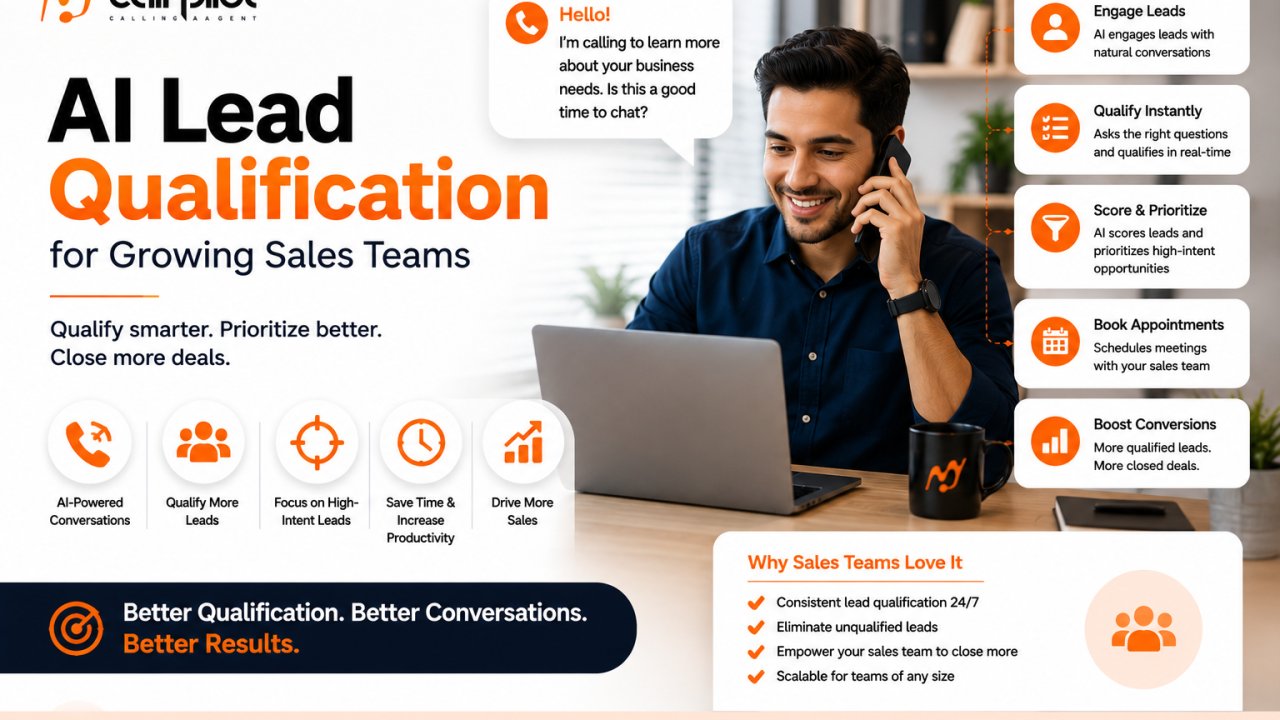
AI lead qualification uses a conversational AI system to talk to a new lead the moment they come in, ask the questions a rep would ask, and decide whether that lead is worth a human's time — before anyone on your team has looked at it. For businesses that get more leads than they can call back fast, it closes the gap between "someone showed interest" and "someone talked to a real prospect," without adding headcount.
If you're evaluating whether to automate qualification, or which platform to trust with it, this page walks through how it actually works, what it costs, where it breaks down, and how to tell if your business is ready for it.
What Is AI Lead Qualification, Exactly?
AI lead qualification is the use of a voice or chat AI agent to have a real, two-way conversation with a new lead — asking about budget, timeline, need, or fit — and then scoring or routing that lead based on the answers, without a rep on the call.
It's different from lead scoring, which ranks leads using data you already have (page views, firmographics, past engagement). Qualification requires new information the lead hasn't given you yet, which is why it has to happen through conversation, not just data analysis. It's also different from a basic chatbot, which typically answers FAQs rather than making a judgment call about fit.
A working AI lead qualification setup usually does three things in sequence:
- Makes contact fast. Calls or texts the lead within minutes of form submission, or answers the inbound call live.
- Asks structured questions. Follows a script built around your qualification criteria — often a variant of BANT (Budget, Authority, Need, Timeline) or CHAMP (Challenges, Authority, Money, Prioritization).
- Routes the outcome. Sends qualified leads straight to a rep's calendar or queue, and either disqualifies, nurtures, or discards the rest — with a transcript and summary logged automatically.
Why Speed Is the Part Most Guides Skip
Most content on this topic jumps straight to "AI asks smart questions." That matters, but it isn't the biggest lever. The biggest lever is how fast contact happens in the first place — because a qualification conversation that never starts can't produce a qualified lead.
📞 62% of calls to small businesses go unanswered, based on an oft-cited analysis of 85 businesses across 58 industries that found only 37.8% of inbound calls were picked up live. The figure originates from a 2016 study and has been repeated widely since, so treat it as directionally reliable rather than a precise current-year measurement — but the underlying pattern (most small-business phones go unanswered some of the time) is corroborated by more recent industry surveys as well.
⚡ A Harvard Business Review analysis of thousands of sales leads found that firms attempting contact within an hour of a query were roughly 7x more likely to qualify the lead than firms that waited even a bit longer, and more than 60x more likely than firms that waited 24 hours or more.
📈 Related research from the same body of work found that 78% of sales tend to go to whichever company responds to the lead first — not necessarily the best product or the lowest price, just the first real conversation.
Put together: a lead qualification system that's accurate but slow is solving the wrong problem. The first job of AI lead qualification is picking up the phone (or replying to the form) before the window closes. The second job is asking good questions once you're on the line.
How AI Lead Qualification Actually Works
For inbound calls and form fills
A lead calls your business number or submits a form. The AI agent answers the call directly, or places an outbound call to the number just submitted, usually within seconds to minutes. It introduces itself, asks the qualifying questions your team defines, and handles natural back-and-forth — including interruptions, "let me check," or questions the lead asks back.
For outbound follow-up and re-engagement
For leads that came in through ads, downloads, or old CRM records, an outbound AI calling flow can work through a list, attempt contact using compliant calling windows, and qualify anyone who picks up — freeing reps from cold-dialing lists that are mostly going to voicemail anyway.
After the conversation
Every call is logged: recording, transcript, and a structured summary of what was learned (fit, timeline, objections raised). Qualified leads get pushed to a calendar link, a rep's queue, or a CRM record with the context attached, so the human conversation starts from "here's what they told us" instead of "hi, can I ask you a few questions."
What Good Qualifying Questions Actually Look Like
Generic FAQ bots ask "how can I help you today?" Qualification requires a structured line of questioning tied to how your team actually decides fit. Two common frameworks:
| Framework | Focus | Best for |
|---|---|---|
| BANT | Budget, Authority, Need, Timeline | Higher-ticket B2B sales with a defined budget owner |
| CHAMP | Challenges, Authority, Money, Prioritization | Teams that want to understand the problem before asking about money |
Neither framework is inherently better — the point is picking one, translating it into 4–6 concrete questions, and giving the AI agent clear rules for what counts as a "yes" on each. Vague criteria produce vague qualification, whether a human or an AI is doing the asking.
The Qualification Debt Curve
Here's a framework worth thinking through before you buy anything: every hour a lead sits unqualified, it accumulates qualification debt — the growing gap between what the lead knew about your business when they reached out and what they remember by the time you call.
In the first 5 minutes, a lead can usually tell you exactly what they need, because they're still looking at the page or offer that made them reach out. By hour one, they're doing something else. By day one, they may not remember submitting the form. The AI didn't get smarter overnight — the lead just paid down less of what they knew, because nobody asked while it was still fresh.
This is why "we'll qualify leads within a business day" is a weaker system than "we qualify leads within minutes," even if the questions asked are identical. Speed doesn't just improve contact odds — it improves the quality of the answers you get once you do connect.
AI vs. the Alternatives
| Human Rep | Voicemail / No System | AI Lead Qualification | |
|---|---|---|---|
| Speed to first contact | Depends on availability | None — lead has to call back | Seconds to minutes, 24/7 |
| Consistency of questions asked | Varies by rep and energy level | N/A | Same structured questions every time |
| Cost to scale | Rises with headcount | Low, but high opportunity cost | Scales with call volume, not headcount |
| Handles nuance and objections | Strong | None | Improving, but still weaker than an experienced rep on complex deals |
| After-hours coverage | Rare without a night shift | Rare without a night shift | Native |
The honest read: AI is a speed and consistency upgrade, not a judgment upgrade. It won't out-negotiate your best closer. It will make sure your best closer never finds out about a hot lead three days too late.
When AI Lead Qualification Is Not the Right Choice
Most vendor content skips this section entirely. A few situations where automating qualification is premature:
- Very low lead volume. If you're getting 5–10 leads a month, a rep can call every one within minutes. The ROI case for automation gets thin until volume is high enough that human response time is genuinely the bottleneck.
- Highly technical or regulated sales cycles where the first conversation requires deep product or compliance expertise the AI can't reliably represent.
- No defined qualification criteria yet. If your team can't agree on what makes a lead "qualified," automating an undefined process just automates the disagreement. Fix the definition first.
- Relationship-first sales motions, such as high-touch enterprise deals where the first call is the relationship-building step, not a filter.
If none of these describe your business, AI lead qualification is likely to pay for itself quickly, since the underlying constraint — response speed at scale — is exactly what it's built to solve.
Industries Where This Tends to Matter Most
- Home services (HVAC, plumbing, electrical, roofing): high call volume, urgent need, and a caller who will call the next number on Google if nobody picks up.
- Real estate: lead volume is high and inconsistent, and buyer intent decays fast after an inquiry.
- Legal intake: every missed call is a potential case walking to a competitor's firm.
- Healthcare and dental scheduling: high call volume, appointment-driven revenue, and staff who are often mid-task and unable to answer.
- B2B SaaS and services: inbound demo requests and free-trial signups where speed-to-lead directly correlates with close rate.
Businesses across markets from mid-sized metros to major metro areas share the same underlying pattern: phone-based lead flow that outpaces the team's ability to respond immediately.
Objections, Answered Honestly
"Will callers know it's AI?" Reputable platforms disclose that callers are speaking with an AI system, both because it builds trust and because disclosure requirements increasingly apply to automated calling. Most callers care more about getting a fast, useful answer than about who — or what — is on the other end.
"What if it doesn't know the answer?" A well-configured agent hands off to a human, takes a message, or schedules a callback rather than guessing. The failure mode to watch for in any platform you evaluate is silent guessing — ask directly how a given system handles questions outside its script.
"Can I still talk to a human?" Yes, in any properly configured setup. AI qualification is a filter and first-responder, not a wall between you and your leads. Escalation paths to a live person should be a baseline requirement, not a premium feature.
"Is it expensive?" Usually priced by minutes or calls handled rather than a flat headcount cost, which means the economics scale with your actual call volume — see the ROI section below for how to run your own numbers.
"Will it replace my sales team?" It replaces the waiting, not the selling. Reps still close. AI just makes sure they're closing conversations that were actually worth having.
What Qualification Costs When You Do It With People vs. AI
There's no single market price for AI lead qualification because platforms differ in what they bundle — some charge per minute of conversation, some per call, some as a flat monthly plan with usage included. What's consistent across the category:
- Per-minute or per-call pricing is common for usage-based platforms, so cost scales with call volume rather than headcount.
- Setup and configuration (scripting, CRM integration, routing rules) is sometimes bundled and sometimes billed separately — ask directly.
- The comparison that matters isn't AI vs. free. It's AI vs. the fully loaded cost of a rep's time spent on calls that would have gone unqualified, unanswered, or unreturned anyway.
My Call Pilot's own plan structure — one plan with managed minutes across receptionist, outbound, and inbound use cases — is described on its site, but specific rate tiers weren't independently verifiable at the time of writing. Confirm current pricing directly before including it in buyer-facing claims.
A Simple Way to Calculate Your Own ROI
You don't need a vendor's case study to know whether this is worth it. Work through your own numbers:
Calls received per month → Calls currently missed or unqualified → Estimated leads lost → Realistic close rate on a qualified lead → Average customer value → Estimated monthly revenue left on the table
For example: if you receive 200 calls a month, miss or mishandle 40% of them, and each converted customer is worth $1,000 with a 20% close rate on qualified leads — that's roughly 80 missed calls, producing an estimated 16 lost qualified opportunities, worth roughly $3,200 in a conservative month. Run the same math with your real numbers before deciding whether automated qualification is worth the monthly cost. No platform can guarantee your specific ROI — but the framework above will tell you, honestly, whether the opportunity is big enough to chase.
Seven Questions to Ask Before You Buy
- What happens when a caller asks something outside the script — does it guess, escalate, or take a message?
- Is pricing per minute, per call, or flat — and what happens when you exceed included usage?
- How is a "qualified" lead defined, and can you customize that definition per campaign?
- Does it integrate with your existing CRM, or does qualified-lead data need manual entry?
- Can you review real call recordings and transcripts before committing, not just a scripted demo?
- What's the actual time-to-live from signup to your first real call handled?
- Who owns compliance for outbound calling — consent, do-not-call lists, and calling-hour restrictions?
Any vendor unwilling to give straight answers to these seven questions is telling you something.
How My Call Pilot Fits In
My Call Pilot is built as a conversational AI platform for exactly this problem: it can launch an AI receptionist to answer inbound calls, run outbound campaigns to follow up on new leads immediately, and add a voice or chat widget to your website — all managed through one platform with usage tracked on a single plan, rather than juggling separate tools for inbound, outbound, and web chat.
For lead qualification specifically, that combination matters because leads don't arrive through one channel. A form fill on your site, an inbound call to your main line, and a chat widget conversation can all funnel into the same qualification logic and the same CRM record, instead of three disconnected systems each capturing partial context.
Frequently Asked Questions
What's the difference between lead qualification and lead scoring?
Lead scoring ranks leads using data you already have, like page visits or company size. Lead qualification gathers new information directly from the lead through conversation — budget, timeline, specific need — which is why it requires a live interaction rather than just data analysis.
How fast should a lead be contacted after they inquire?
As close to immediately as possible. Research on lead response time consistently shows qualification odds drop sharply as minutes pass, so "same day" is a meaningfully worse target than "same minute" when it's achievable.
Can AI lead qualification handle outbound calls, not just inbound?
Yes — platforms built for this typically support both inbound call answering and outbound follow-up campaigns to new or existing leads, often as part of the same system.
Does the caller know they're talking to an AI?
On reputable platforms, yes. Clear AI disclosure at the start of a call is both a trust practice and, in many jurisdictions, a compliance requirement for automated calling.
Will AI qualification replace my sales reps?
No — it replaces the delay between a lead showing interest and a human finding out about it. Reps still handle the actual selling conversation once a lead is qualified and routed.
How much does AI lead qualification typically cost?
Most platforms price by call volume or minutes rather than a flat per-seat fee, so cost scales with how many leads you're actually processing. Get a specific quote before assuming a number — pricing structures vary meaningfully across vendors.
What industries benefit most from automating this?
Businesses with high inbound call volume and time-sensitive leads — home services, real estate, legal intake, healthcare scheduling, and B2B SaaS demo requests — tend to see the fastest payback, because the underlying problem (response speed at scale) is most acute there.
The Next Step
If your business is missing calls, letting form fills sit for hours, or asking reps to spend their mornings calling people who were never going to buy — the fix isn't more headcount. It's making sure every lead gets a fast, structured first conversation, and only the real opportunities land on a human's calendar.