On this page (14)
- What Is an AI Receptionist for a Dealership?
- Why Dealerships Lose Calls in the First Place
- Sales Calls and Service Calls Are Not the Same Job
- How an AI Receptionist Fits Into a Dealership's Systems
- What an AI Receptionist Should Handle at a Dealership
- Why This Matters Beyond a Single Missed Call
- Evaluating a Vendor, 7 Questions Worth Asking
- A Simple Way to Estimate Your Own Missed Call Cost
- Common Questions From Dealers
- Can it quote price or financing terms?
- Will it replace my BDC?
- Does it work for both sales and service?
- How does it connect to our DMS and CRM?
- Choosing an AI Receptionist for Your Store
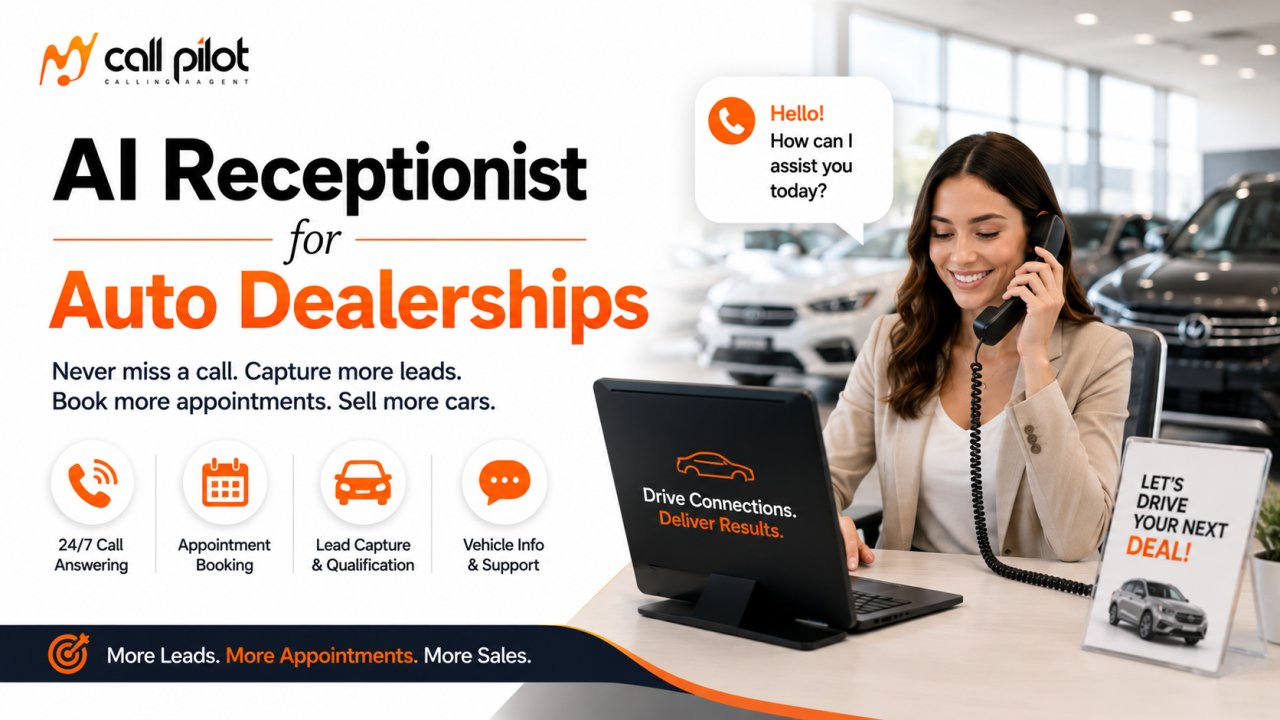
AI receptionist for auto dealerships technology answers sales and service calls, books appointments, and keeps the phone covered when your BDC and service advisors are already on the line or off the clock.
A dealership phone rings for a different reason almost every time. A shopper wants to know if a specific trim is still on the lot. A service customer needs an oil change slot before work on Monday. A past buyer is calling about a recall notice. Every one of those calls is a real opportunity, and every one of them is competing with a front desk that is already busy, a BDC that is already on another line, and a service lane that fills up fast on Monday and Tuesday mornings. An AI receptionist exists to make sure none of those calls just disappear.
What Is an AI Receptionist for a Dealership?
An AI receptionist for a dealership is a voice AI system that answers inbound calls to your sales and service lines, holds a real conversation with the caller, and completes the task the caller actually wants done, such as checking vehicle availability, booking a service appointment, or capturing a sales lead, rather than just taking a message. Unlike a basic phone menu, it understands open ended questions and responds the way a trained front desk employee would, then hands the details off to your team or writes them directly into your systems.
Why Dealerships Lose Calls in the First Place
📞 A typical active dealership misses somewhere between 300 and 500 calls a week across sales and service, according to call data reviewed by Numa. Independent research from DaveAI's analysis of roughly 600 dealerships puts the combined miss rate at close to one in four inbound calls.
⏱️ Hold time is a major driver, not just staffing gaps. Car Wars data cited by multiple industry sources shows roughly 32% of dealership calls end in hold abandonment, with average hold times running past three minutes before a customer gives up.
🌙 After hours is worse. One analysis found 65.9% of callers hang up without leaving a message around 8pm, and 62.4% do the same around 7pm, even though the store's inventory and service calendar do not stop being relevant just because the doors are closed.
💵 The dollar impact is significant and industry estimates vary by methodology. Some analyses put service department revenue at risk from missed appointment calls at $850,000 to over $1 million a year, based on an average repair order in the $450 to $586 range and a realistic book rate on missed calls. These are worked examples built from published averages, not a claim about any specific store, and your own number will depend on your call volume, your closing ratio, and your average repair order or gross per deal.
📉 The behavior data matters as much as the dollar figure. Multiple sources report that roughly 75% to 85% of callers who reach voicemail or a busy signal will not call back, they call the next dealer instead. A missed call at a dealership is rarely a delayed sale. It is usually a sale that happened somewhere else.
Sales Calls and Service Calls Are Not the Same Job
This is where a lot of automotive AI content gets vague, and it matters enough to spell out clearly.
A sales call is almost always about a specific vehicle or a specific question that determines whether the shopper drives to your lot or the next one. The AI needs current, accurate inventory information, since a wrong answer about availability or pricing is worse than no answer at all, and it needs to move quickly toward booking a test drive or connecting the caller to a salesperson while the interest is still warm.
A service call is almost always about scheduling, and the caller usually already knows what they need done. The AI needs live access to the actual service calendar, not a general availability guess, so it can confirm a real appointment slot during the call instead of promising a callback that may or may not happen before the customer tries someone else.
Treating these as one generic call type is the single most common way an AI receptionist underperforms at a dealership. A system built for either job in isolation will handle the other one poorly.
How an AI Receptionist Fits Into a Dealership's Systems
The value of an AI receptionist at a dealership depends heavily on how deeply it connects to the tools your team already uses, not just how natural the conversation sounds.
Most dealerships run on a DMS such as CDK, Reynolds and Reynolds, or Tekion, paired with a CRM such as VinSolutions, DealerSocket, or Elead. An AI receptionist that only takes a message and creates a task for a human to act on later is doing a fraction of the job compared to one that reads live calendar availability and writes a confirmed appointment directly back into the scheduler during the call itself, sometimes called write back integration. The difference matters in practice. A caller who is told their appointment is confirmed on the call is far less likely to shop elsewhere than one who is told someone will call them back.
My Call Pilot's platform is built around one conversational AI system that covers inbound answering, outbound calling, and website voice and chat widgets on a single plan managed by minutes. Because specific DMS and CRM integration support can change and depends on your dealership's exact setup, confirm current integration options directly with the team rather than assuming a specific system is supported out of the box.
What an AI Receptionist Should Handle at a Dealership
- Answering every inbound sales and service call, including nights, weekends, and peak hold time windows
- Answering vehicle availability, trim, and general pricing range questions using current inventory data
- Booking test drives and connecting hot leads to a salesperson while interest is still fresh
- Booking, confirming, or rescheduling service appointments against a live calendar
- Capturing complete caller information and call intent so your BDC or service advisor opens a record that already has the context
- Escalating pricing, financing, and anything outside its configured scope to a human, rather than guessing
Why This Matters Beyond a Single Missed Call
Service retention is tied more closely to phone experience than most stores realize. Cox Automotive's 2025 Service Industry Study found that customers who service their vehicle at the selling dealership are 74% more likely to buy their next vehicle from that same store. Every missed service call is not just a lost repair order, it is a small crack in a relationship that drives future vehicle sales.
Evaluating a Vendor, 7 Questions Worth Asking
- Does it handle sales and service calls differently, with different data sources for each, or is it one generic script for every call?
- Can it write a confirmed appointment directly into your DMS or scheduler during the call, or does it only create a task for a human to finish?
- How does it access your current inventory, and how often does that data refresh?
- What happens when a caller asks about price or financing? A well built system should route that to a human rather than quoting anything, since inaccurate pricing or financing statements can create real compliance exposure under rules like the FTC's Combating Auto Retail Scams rule.
- Does it disclose that the caller is speaking with an AI system, and does it handle call recording disclosure where your state requires it?
- For outbound calls such as service reminders or follow up, how does the vendor handle consent under the Telephone Consumer Protection Act, since AI generated voice calls are treated the same as other automated calls under current FCC guidance?
- How long does setup actually take once you include DMS and CRM integration, not just the demo call?
None of this is legal advice, and compliance rules around AI calling and disclosure continue to evolve by state, so confirm current requirements with your own counsel before launching outbound AI calling specifically.
A Simple Way to Estimate Your Own Missed Call Cost
Industry averages are a starting point, not your actual number. A straightforward way to estimate your own exposure.
Missed calls per month, multiplied by a realistic book rate for calls that would have converted if answered well, multiplied by your show rate for booked appointments, multiplied by your average repair order or average front end gross depending on whether you are looking at service or sales.
For example, a service department missing 150 appointment related calls a month, with a 40% realistic book rate, an 80% show rate, and a $500 average repair order is looking at roughly 150 times 0.40 times 0.80 times $500, which is about $24,000 a month in unrealized service revenue, before counting the downstream effect on future vehicle sales from customers who never became service loyal. Run this with your own numbers rather than a published national average, since call volume, closing ratio, and repair order value all vary significantly by store.
Common Questions From Dealers
Will customers know they are talking to an AI?
In most configurations, yes, since disclosure at the start of the call is increasingly expected under state rules and is good practice regardless. The more important question is whether the call gets handled correctly, not whether the AI is disguised as a person.
Can it quote price or financing terms?
It should not, and this is one of the most important settings to confirm with any vendor. Pricing and financing discussions carry real regulatory exposure and should route to a trained team member.
Will it replace my BDC?
For most stores the goal is coverage, not replacement, catching the calls that come in when the BDC is already on another line, when the store is closed, or during a volume spike your current staffing was not built for.
Does it work for both sales and service?
It should be configured for both, since the two call types need different information and different urgency. Confirm the vendor treats them as separate workflows rather than one generic script.
What about outbound calls like service reminders?
Outbound AI calling to consumers is subject to consent requirements under the Telephone Consumer Protection Act, and requirements vary depending on whether the call is informational or promotional. Confirm your consent capture process with the vendor and your own legal counsel before turning on outbound campaigns.
How does it connect to our DMS and CRM?
Integration depth varies by platform and by vendor. Ask specifically whether the system can write appointments and lead records directly into your systems during the call, or whether it only creates a task for someone to finish manually.
Choosing an AI Receptionist for Your Store
If your phones are the reason a shopper never made it to your lot or a service customer never made it back for their next oil change, the fastest way to know if this is worth fixing is to run your own missed call estimate above, then hold any vendor you evaluate to the 7 questions in this page, especially the ones about DMS write back and pricing disclosure.
My Call Pilot brings inbound answering, outbound calling, and website voice and chat widgets together on one platform, with usage managed as minutes on a single plan, so your call handling works the same way whether a customer reaches out by phone or through your website.