On this page (29)
- What an AI Receptionist for Law Firms Actually Does
- Why This Matters More for Law Firms Than for Most Businesses
- The Confidentiality and Ethics Questions You Actually Need Answered
- Can an AI receptionist be covered by attorney client privilege?
- What do bar rules actually require?
- Could using an AI tool ever risk unauthorized practice of law?
- What should you ask a vendor before signing up?
- Who This Is Built For
- When an AI Receptionist Is Not the Right Fit for a Law Firm
- AI Receptionist Compared to the Alternatives for Law Firms
- What It Costs
- 9 Questions to Ask Before Choosing an AI Receptionist for Your Firm
- Common Objections, Answered Honestly
- Will an AI receptionist accidentally give legal advice?
- Does using an AI tool put attorney client privilege at risk?
- Will callers know they're talking to AI?
- Can it replace my intake staff?
- Is it worth the cost for a smaller firm?
- How fast can we actually get this running?
- A Simple Way to Calculate What Missed Calls Cost Your Firm
- Frequently Asked Questions
- What is an AI receptionist for law firms?
- Is it legal for a law firm to use an AI receptionist?
- Does it protect attorney client privilege?
- How much does an AI receptionist for a law firm cost?
- Can it screen for conflicts of interest?
- Will it integrate with my practice management software?
- Can a caller still reach a human?
- Where My Call Pilot Fits
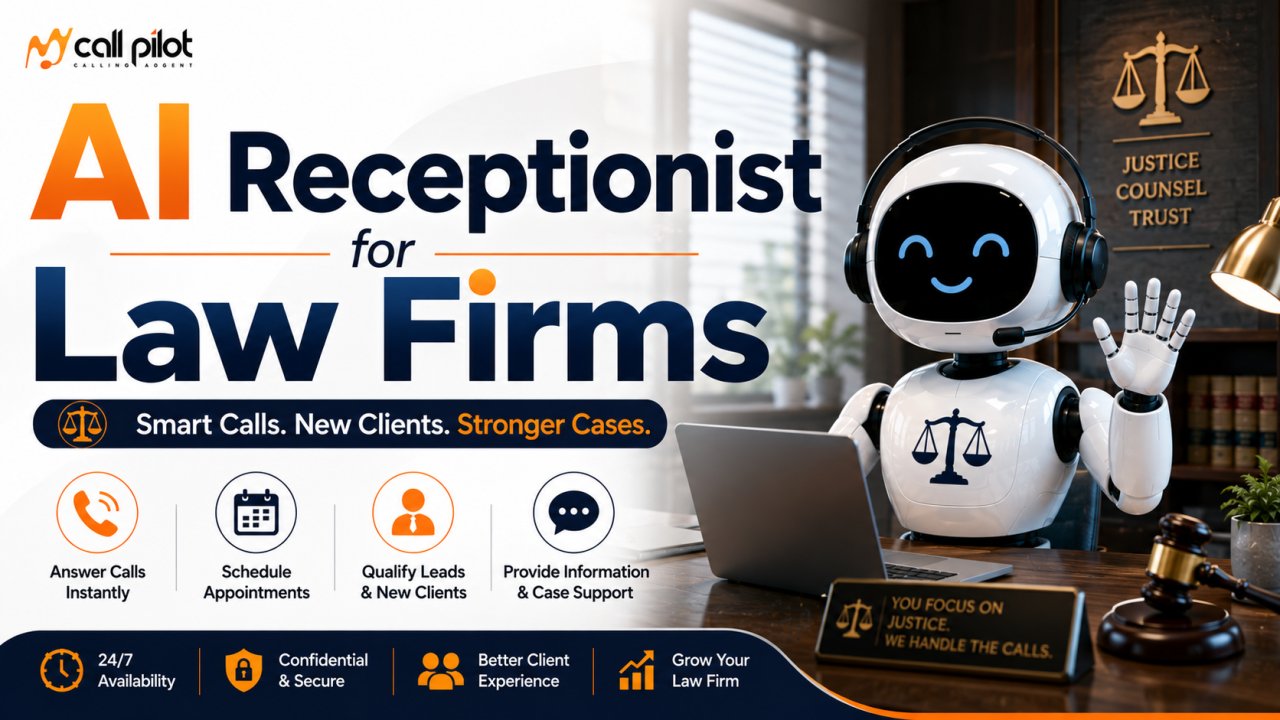
AI receptionist for law firms technology answers every incoming call, screens the caller and captures the case details your intake process needs, even when your front desk is closed, in a deposition, or already on another line. For a profession where the first phone call often decides which firm gets the case, that coverage gap is one of the most expensive problems a practice can leave unsolved.
An AI receptionist built for legal work is not the same as a general small business answering tool with a law firm logo on it. It has to hold a caller's attention long enough to gather real intake information, avoid anything that resembles legal advice and treat what it hears with the same care your staff already applies to client communications.
My Call Pilot is a conversational AI platform that firms can configure as their inbound answering point, alongside outbound follow up calling and a website voice or chat widget, all managed under one plan rather than several separate tools.
What an AI Receptionist for Law Firms Actually Does
An AI receptionist for a law firm answers inbound calls, asks structured intake questions specific to the practice area and either books a consultation or routes the caller to the right person, without offering legal advice or making decisions about a case.
A typical call moves through a few stages.
The caller reaches your number, whether it's forwarded after hours, during peak call volume, or all the time depending on how you configure it.
The AI answers immediately in a professional tone and asks what kind of matter the caller needs help with.
It gathers the intake information your firm actually needs, such as practice area, basic facts about the situation and contact details, using questions your firm defines in advance.
It identifies anything urgent, such as an active arrest, a filing deadline, or a caller already represented by opposing counsel, and flags or routes those calls differently than a routine inquiry.
It books a consultation directly if your calendar allows it, or takes a detailed message for a specific attorney or paralegal to follow up.
Everything is logged as a transcript or summary, so intake information does not depend on someone remembering to write it down correctly.
What the AI receptionist should never do is answer a legal question, offer an opinion on the merits of a case, or make any statement that could be read as legal advice. Good intake scripts are built specifically to avoid that line.
Why This Matters More for Law Firms Than for Most Businesses
📞 Only about 40% of U.S. law firms answer a prospective client's call on the first attempt, down from 56% in 2019. That decline happened while client expectations for immediate response were rising, not falling.
☎️ Law firms miss roughly 36% of incoming calls overall and about 34% of those callers never try the firm again. A missed call in this industry is rarely a minor inconvenience. It is frequently a lost retainer.
🌙 Around 60% of after hours and weekend calls come from first time callers rather than existing clients. That is new business showing up at the exact hours most firms have no one answering the phone.
⏱️ Voicemail and callback requests see roughly a 74% drop off rate, because prospective legal clients increasingly expect an immediate response rather than a promise of one. People calling about a divorce, an arrest, or an injury are rarely willing to wait.
💰 Legal services carry the highest average cost per lead of any industry tracked in Google and Microsoft paid search, at $131.63 per lead as of 2026, nearly double the all industry average of $66.69. Every call that goes unanswered after that spend is an expensive loss, not just a missed conversation.
Published figures on exact legal call answer rates vary somewhat by study and methodology, since some measure the share of firms that answer at all while others measure the share of individual calls answered. The consistent theme across every credible source is the same. A large share of legal intake calls go unanswered and unanswered legal calls convert to clients far less often than answered ones.
The Confidentiality and Ethics Questions You Actually Need Answered
This section is general information about common ethical considerations raised by legal technology commentary and bar guidance. It is not legal advice and every firm should confirm specifics with its own bar association and ethics counsel before deploying any AI tool.
Can an AI receptionist be covered by attorney client privilege?
Communications with non-attorney staff, such as paralegals and legal assistants, are generally treated as extensions of the attorney's own confidentiality obligations when those staff are properly bound to protect client information. Legal commentary discussing AI receptionists generally extends similar reasoning to a vendor acting as the firm's agent, provided the vendor is bound by a written confidentiality agreement and handles data appropriately. This is a legal question specific to your jurisdiction, not a guarantee any particular product provides, so confirm it directly with any vendor and, where needed, your own ethics counsel.
What do bar rules actually require?
ABA Model Rule 1.6 requires attorneys to make reasonable efforts to prevent unauthorized disclosure of client information. ABA Formal Opinion 512, issued in 2024, addresses generative AI specifically and reinforces that attorneys remain responsible for supervising any AI tool used in their practice, similar to the existing supervisory duties under Model Rules 5.1 and 5.3 for nonlawyer staff. State bars have issued their own guidance as well, so check your specific jurisdiction.
Could using an AI tool ever risk unauthorized practice of law?
Model Rule 5.5 governs unauthorized practice of law. An AI receptionist that sticks to intake, scheduling and factual information gathering stays on the administrative side of that line. A tool that answers legal questions, evaluates the strength of a case, or gives an opinion about likely outcomes risks crossing it. This is one of the clearest reasons to insist on a legal specific intake script rather than a generic small business answering flow.
What should you ask a vendor before signing up?
Ask directly how call data is encrypted, both while it's being transmitted and while it's stored. Ask who at the vendor can access transcripts and recordings, and under what circumstances. Ask whether the vendor will sign a written confidentiality agreement or data processing agreement. Ask whether your data is ever used to train shared AI models, and if so, ask for the ability to opt out. None of these are unusual questions and any serious vendor should be able to answer all of them clearly.
Who This Is Built For
Firms where new client calls drive case volume, and where staff cannot realistically staff the phone every hour a prospective client might call, are the clearest fit for an AI receptionist.
That commonly includes personal injury firms, where an emergency call at any hour can be the highest value case of the year.
Family law practices, where calls often come from people in crisis outside normal business hours.
Criminal defense firms, where an arrest does not wait for office hours to happen.
Immigration practices, where consultation requests come from callers in many time zones and sometimes multiple languages.
Solo attorneys and small firms without a dedicated front desk, where every attorney hour spent answering routine calls is an hour not spent billing.
If your firm receives very few new client calls, or if your intake process depends entirely on referrals with no cold inbound volume, the case for a dedicated AI receptionist is weaker and a simpler tool may cover what you need.
When an AI Receptionist Is Not the Right Fit for a Law Firm
Being honest about this up front saves everyone time later.
An AI receptionist is probably not the right choice if your firm handles matters where every single caller genuinely needs immediate attorney judgment on the line, and no amount of structured intake can substitute for that, such as a narrow emergency practice where minutes and specific legal counsel matter more than intake data.
It is also not the right fit if your firm is unwilling to define clear routing rules for urgent versus routine calls, since a tool without that configuration will treat every caller the same way a person using poor judgment would.
And it is not the right fit if your bar association or malpractice carrier has specific restrictions on AI handling of prospective client communications that your firm has not yet reviewed. Check that first.
In those situations, a live legal answering service or additional in-house staff may serve the firm better than an automated tool.
AI Receptionist Compared to the Alternatives for Law Firms
| Option | Covers after hours | Legal specific intake | Typical monthly cost | Best fit |
|---|---|---|---|---|
| Voicemail only | No, callers rarely leave a message | No | Free | Extremely low call volume firms |
| In house receptionist | No, limited to office hours | Depends on training | Roughly $35,000 to $50,000 per year fully loaded | Firms wanting a dedicated in person presence |
| Live legal answering service | Yes, via human agents | Often yes, with legal trained staff | Roughly $300 to $1,500 or more per month depending on volume | Firms prioritizing a human voice on every call |
| Generic AI receptionist | Yes | Rarely tailored to legal intake | Roughly $25 to $300 per month | Firms with simple, low sensitivity call volume |
| AI receptionist built for legal intake | Yes | Yes, when properly configured | Varies by provider and call volume | Firms wanting 24/7 coverage with legal specific screening |
Figures above reflect ranges reported across current legal answering service and receptionist pricing coverage, not a claim about any single vendor's exact rate.
What It Costs
Legal answering and AI receptionist pricing generally ranges from roughly $25 per month for basic AI only plans to $800 or more per month for hybrid AI and human coverage, with live legal answering services often running $300 to $1,500 or more per month depending on call volume.
Pricing models in this category typically fall into a few patterns.
Flat monthly plans with an included call or minute bundle, plus overage charges once you exceed it.
Per minute pricing, which fits firms with unpredictable call length.
Per call pricing, which fits firms with short, fairly consistent intake calls.
Hybrid AI and human tiers, which typically cost more but add a live agent for calls the AI hands off.
For comparison, a fully loaded in house legal receptionist typically costs somewhere in the range of $35,000 to $50,000 per year once salary, benefits, training and turnover are factored in, well above the median receptionist wage of roughly $17.90 per hour, since legal front desk staff often require additional training on confidentiality and intake procedure.
Confirm current legal plan pricing directly on mycallpilot.ai. The platform's underlying structure, one plan covering inbound answering, outbound follow up and web based contact, is built to avoid the cost of stitching together separate legal answering, follow up calling and website chat tools from different vendors.
9 Questions to Ask Before Choosing an AI Receptionist for Your Firm
Price and call volume are the easy questions. These are the ones that actually predict whether the tool will hold up under real legal intake pressure.
- Does the intake script ask practice area specific questions, or is it a generic small business template with your firm's name on it.
- How does the system identify a genuinely urgent call and route it differently than a routine inquiry.
- Will the vendor sign a written confidentiality or data processing agreement, and can you review it before committing.
- How is call data encrypted, both in transit and while stored.
- Does the tool book directly into the practice management software you already use, or does someone still have to enter everything manually.
- What happens when a caller asks a direct legal question. Does the AI decline cleanly, or does it risk answering in a way that could look like legal advice.
- Can you review real call transcripts before going live, so you can confirm the tone and accuracy match your firm's standards.
- Is your firm's data ever used to train shared AI models, and can you opt out.
- How long does setup actually take, and does your staff need to configure it themselves or does the vendor handle it.
Bring this list into any vendor conversation, including one with My Call Pilot. A vendor that answers all nine clearly and specifically is worth serious consideration.
Common Objections, Answered Honestly
Will an AI receptionist accidentally give legal advice?
It shouldn't, if it's properly configured with a legal specific intake script that sticks to factual questions and routes anything requiring judgment to a person. This is exactly why question six in the checklist above matters. Ask any vendor to walk you through how their system avoids this before you sign up.
Does using an AI tool put attorney client privilege at risk?
It can, if the vendor's data handling practices are not appropriate for privileged communications, similar to the risk raised by any third party tool touching client information. This is a real and actively discussed concern in legal ethics commentary, not a hypothetical one. It is also manageable with the right vendor agreements and data practices in place. Confirm specifics with your own ethics counsel rather than relying on any vendor's marketing claims alone.
Will callers know they're talking to AI?
Often they can tell, especially attentive callers. Most legal intake commentary suggests that transparency, telling a caller they're speaking with an automated intake assistant when asked, tends to build more trust than trying to disguise it, and may also be advisable from a disclosure standpoint depending on your jurisdiction.
Can it replace my intake staff?
It's generally positioned to absorb after hours and overflow call volume while staff continue to handle complex intake conversations and anything requiring judgment, rather than fully replacing a trained intake team.
Is it worth the cost for a smaller firm?
That depends on your call volume and what a single missed case is worth to your firm. The math below gives you a way to check that for your own numbers rather than relying on an industry average.
How fast can we actually get this running?
Setup time varies significantly by vendor. Ask directly, as in question nine above, before assuming any specific timeline.
A Simple Way to Calculate What Missed Calls Cost Your Firm
Industry statistics are useful context, not your specific answer. Here is a framework for running your own numbers.
Start with new client calls received per month. Apply your own miss rate, or use a general benchmark such as the roughly one third miss rate if you don't track your own yet. Estimate how many of the calls you do answer convert into a signed case. Multiply that by your average case value.
For example, a firm receiving 80 new client calls a month that misses a quarter of them, converts 1 in 6 of the calls it does answer into a signed case and has an average case value of $8,000 is looking at roughly 20 missed calls a month, translating to a few potential lost cases and tens of thousands of dollars in missed case value, against a phone system that costs a small fraction of that.
This is decision support math, not a guarantee. Actual conversion depends on your practice area, your intake quality and how the case is handled after the call, not just whether the phone was answered.
Frequently Asked Questions
What is an AI receptionist for law firms?
It's a conversational AI tool that answers inbound calls to a law firm, gathers structured intake information specific to the practice area, identifies urgent matters and books consultations or routes callers to staff, without offering legal advice.
Is it legal for a law firm to use an AI receptionist?
Using AI for administrative intake tasks such as scheduling and information gathering is generally considered acceptable under current bar guidance, as long as the tool doesn't cross into giving legal advice or evaluating a case, and the firm follows its confidentiality obligations under rules like ABA Model Rule 1.6. Confirm specifics with your own bar association, since guidance varies by jurisdiction.
Does it protect attorney client privilege?
It can, when the vendor is properly bound by confidentiality agreements and appropriate data handling practices, similar to how privilege extends to properly supervised non attorney staff. This depends heavily on the specific vendor's practices and your own firm's setup, so verify directly rather than assuming.
How much does an AI receptionist for a law firm cost?
Pricing generally ranges from roughly $25 per month for basic AI only plans to $800 or more per month for hybrid AI and human coverage. Exact cost depends on call volume and features.
Can it screen for conflicts of interest?
Some legal specific tools offer conflict screening against a firm's existing client database as an advanced feature. This is not a universal capability, so confirm directly with any vendor, including My Call Pilot, whether and how conflict screening is supported.
Will it integrate with my practice management software?
Many legal receptionist tools integrate with platforms like Clio, MyCase, or PracticePanther, though the depth of integration varies significantly by vendor. Confirm which specific integrations are supported before committing.
Can a caller still reach a human?
Yes, in a properly configured system. Urgent or complex calls should route to a live attorney or staff member rather than staying with the AI for the entire interaction.
Where My Call Pilot Fits
My Call Pilot is a conversational AI platform built to sit behind a firm's phone number, handling inbound answering, outbound follow up and website based voice or chat contact under one plan rather than several disconnected tools.
If your firm's honest self assessment above points toward a narrow emergency practice with no tolerance for structured intake, or unresolved questions from your bar association about AI handling prospective client communications, work through those first. If your firm is missing after hours and overflow calls, juggling separate tools for answering, follow up and website contact, or simply looking for a more consistent first response for prospective clients, that is the specific gap My Call Pilot is built to close. Confirm legal specific configuration options, data handling practices and current pricing directly with the My Call Pilot team before making a decision.