On this page (10)
- Why Tire Shops Miss So Many Calls
- How an AI Receptionist Works for a Tire Shop
- What a Tire Shop Specific AI Receptionist Should Handle
- Choosing Between Staffing Options for Front Counter Coverage
- When an AI Receptionist Might Not Be the Right Fit Yet
- Questions to Ask Before Choosing an AI Receptionist for Your Shop
- What Does an AI Receptionist Cost for a Tire Shop
- Common Questions About AI Receptionists for Tire Shops
- Do we still need a front counter person?
- Why Tire Shops Choose My Call Pilot
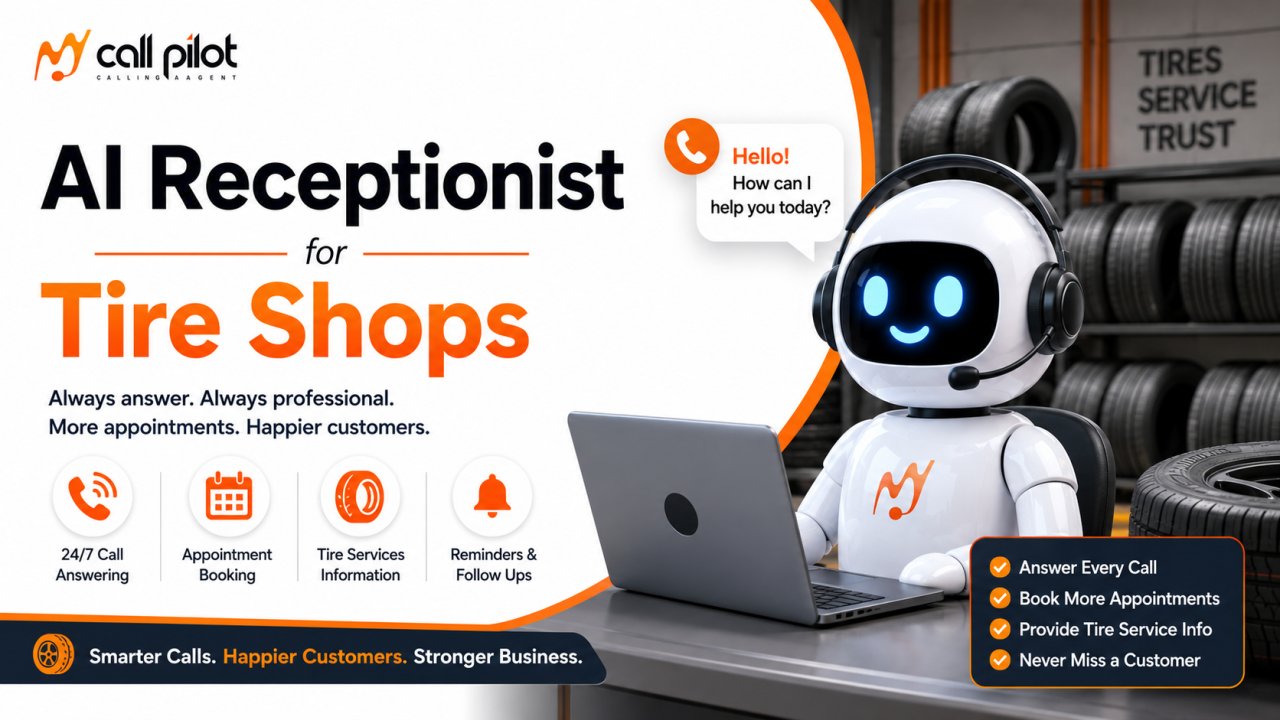
An AI receptionist for tire shops answers every incoming call about tire pricing, availability, and appointments, even when every tech is on the bay floor and the front counter is empty. Instead of a caller hitting voicemail during a Saturday rush or after closing on a Friday, the AI answers immediately, quotes tire information from your actual inventory and pricing sheet, books the appointment into your schedule, and hands off to a real person for anything that needs one, like a fleet account or a warranty dispute.
Tire shops run on a schedule most office jobs don't. Bays fill up fast, seasonal changeover weeks turn a normal week into a flood of calls, and the person who could answer the phone is usually the same person who needs to be under a car. This page covers what an AI receptionist actually does for a tire shop, what it costs, and how to roll it out without disrupting how your shop already runs.
Why Tire Shops Miss So Many Calls
A tire shop's phone rings hardest at exactly the moments nobody is free to answer it. A tech pulling a tire off a rim can't drop everything for a price check call. A service writer helping a walk in customer at the counter can't also field a call about winter tire availability. During seasonal changeover weeks (spring and fall) or after a hailstorm or nail heavy road event, call volume can spike well beyond normal staffing, and every unanswered call during that window is a lost same day sale.
Published research on home service and automotive call handling gives a useful, if imperfect, picture of the scale of this problem, since tire shop specific studies are not widely published.
📞 One AI answering vendor's analysis of home service call data found an average missed call rate near 27%, meaning roughly one in four calls to a busy service business goes unanswered. This figure comes from a vendor's own dataset of home service businesses rather than a tire shop specific study, and should be treated as a directional estimate for a comparably busy, understaffed front counter rather than an exact tire industry number.
💸 The same dataset estimated an average of $1,200 in lost revenue per missed call across the home service businesses it tracked, with figures varying by trade. Again, this is vendor reported data from adjacent service trades, not a tire industry specific figure, but it illustrates the scale of what a single missed call can represent when the caller was ready to book.
🚗 Industry data on automotive call behavior has shown that roughly a quarter of auto shoppers make first contact with a dealership or shop by phone rather than online, underscoring how much of the buying decision still happens on a call rather than a form fill.
☎️ Separately, vendor research on missed call follow up found that a large majority of callers who don't reach anyone simply move on rather than leaving a voicemail, which matches what most shop owners already suspect from watching their own call logs.
What matters more than any single statistic is your own shop's numbers. A simple way to estimate the real cost.
- Calls received during a typical week
- Minus calls actually answered promptly
- Equals missed calls
- Times your typical quote to booked appointment rate
- Times your average ticket value per tire service visit
- Equals your estimated weekly revenue at risk
Running this once, even roughly, usually makes the case for an AI receptionist clearer than any general industry statistic could.
How an AI Receptionist Works for a Tire Shop
An AI receptionist for a tire shop is built around your actual pricing, inventory, and scheduling, not a generic script. On My Call Pilot specifically, this means a calling agent configured with a knowledge base built from your tire pricing sheet, service menu, hours, and common policies (rotation intervals, warranty basics, financing options if you offer them), connected to live call transfer rules and calendar booking.
In practice this looks like the following.
A customer calls asking whether you carry a specific tire size for their SUV. The AI checks the connected knowledge base, answers with your actual pricing and availability information, and offers to book an installation appointment directly into your schedule (Google or Zoho calendar), rather than just taking a message and hoping someone calls back.
A caller during a Saturday rush wants to know your current wait time before driving over. The AI gives a straight answer based on information your team keeps updated, and books a slot if one is open, instead of the call going to voicemail because every counter person is mid conversation with a walk in.
A fleet account manager calls about a bulk order or a billing question. The AI recognizes this falls outside what it should handle alone and transfers live to the appropriate person during business hours, or takes detailed notes and a callback request after hours, rather than trying to negotiate fleet pricing itself.
An after hours caller with a flat tire wants to know your opening time and whether you take walk ins. The AI answers immediately at 9pm on a Sunday, when the shop is closed and nobody would otherwise be there to take the call.
Every one of these calls produces a transcript, an AI generated summary, and analytics your manager can review the next morning, so nothing depends on someone remembering to relay a message correctly.
What a Tire Shop Specific AI Receptionist Should Handle
Tire Pricing and Availability Answering questions about tire sizes, brands, and pricing directly from your actual inventory and price sheet, rather than a generic "call back for pricing" response.
Appointment Scheduling Booking installations, rotations, alignments, and inspections directly into your shop's calendar, including matching realistic time slots to your actual bay capacity.
Seasonal Changeover Handling Managing the surge in calls during spring and fall tire swap season, when call volume can multiply well beyond a normal week.
Fleet Account Routing Recognizing commercial or fleet callers and routing them to the right person rather than attempting to quote bulk pricing on its own.
After Hours Coverage Answering calls, capturing details, and offering next available appointment times when the shop is closed, instead of sending every after hours caller to voicemail.
Warranty and Policy Questions Answering common policy questions (road hazard coverage basics, rotation intervals, return windows) from your documented policies, and transferring anything that needs a manager's judgment call.
Choosing Between Staffing Options for Front Counter Coverage
| Approach | Coverage During Bay Rush | After Hours Coverage | Cost to Add Coverage | Best Fit |
|---|---|---|---|---|
| Existing staff only | Inconsistent, drops during rush | None | Overtime or additional hire | Very low call volume shops |
| Hire additional front counter staff | Consistent during shift | None unless staffing extends hours | Ongoing salary, training, turnover | Higher volume shops with budget for headcount |
| Human answering service | Consistent, but generic scripts | Yes, but limited tire knowledge | Per minute cost, adds up with volume | Shops needing basic message taking only |
| AI receptionist | Consistent, unaffected by call spikes | Yes, full coverage | Flat monthly cost, scales without added headcount | Shops that want accurate tire answers and booking around the clock |
When an AI Receptionist Might Not Be the Right Fit Yet
Worth saying plainly. If your shop takes very few calls per week and your current team comfortably keeps up, the ongoing cost of a platform may not be worth it yet. If your pricing changes constantly and nobody has time to keep a knowledge base updated, the AI's answers will drift out of date quickly and cause more frustration than they solve. And if most of your calls genuinely need a technician's judgment (unusual tire damage, complex alignment issues), plan for the AI to qualify and route those calls rather than expecting it to resolve them directly.
Questions to Ask Before Choosing an AI Receptionist for Your Shop
- Can it be configured with your actual tire pricing and inventory, or only generic scripts?
- How easily can your team update pricing and hours themselves without a developer?
- Does it book directly into the calendar your shop already uses?
- What happens when a caller asks something outside its knowledge, does it guess or transfer cleanly?
- Can it handle a sudden spike in calls during a seasonal changeover week without extra setup?
- Can you review call transcripts and summaries to catch mistakes early?
What Does an AI Receptionist Cost for a Tire Shop
Pricing for AI receptionist platforms generally follows a flat monthly subscription with included call minutes, or per minute pricing that scales directly with volume. My Call Pilot uses a flat monthly subscription model. The Starter plan runs $499 per month with 1,000 minutes and 2 phone numbers, roughly enough for around 300 calls per month, a reasonable starting point for a single location shop.
The Pro plan runs $999 per month with 2,500 minutes and 5 numbers, roughly 800 calls per month, and adds the website voice and chat widget, SMS campaigns, and inbound IVR, a common fit for a busier shop or a small multi bay operation. The Enterprise plan is custom priced and includes white label branding, single sign on, and dedicated infrastructure, generally suited to multi location tire chains. Paying yearly saves 8% compared to monthly billing.
Compare any provider's pricing against your own missed call math from earlier on this page rather than the sticker price alone. A single recovered tire and installation sale most months often covers a meaningful share of the monthly cost.
Common Questions About AI Receptionists for Tire Shops
Will it actually know our tire pricing and what we have in stock?
Only if it's connected to your actual pricing and inventory information. Ask any provider directly how pricing gets loaded in and how easily your team can update it when prices or stock change.
Can customers still book with a real appointment, not just a callback promise?
Yes, on a well configured system. Calendar integration lets the AI book directly into your existing schedule rather than just taking a message.
What happens with fleet accounts and bulk pricing questions?
A well configured AI recognizes these as outside its scope and transfers to the right person, or logs the details for a callback, rather than attempting to negotiate pricing itself.
Will it handle the spring and fall rush without falling apart?
This depends on the platform's call capacity, not just its intelligence. Ask any provider directly about concurrent call handling during high volume periods.
Do we still need a front counter person?
Most shops keep staff for hands on customer interaction, tire fitting, and complex questions. The AI absorbs the calls that would otherwise go unanswered, rather than replacing the counter entirely.
Is it hard to set up for a shop that isn't very technical? Setup effort depends more on how organized your pricing and policy information already is than on the platform itself. Shops with a clear price sheet and service menu typically get set up faster.
Why Tire Shops Choose My Call Pilot
My Call Pilot connects inbound calls, outbound follow up, a website chat and voice widget, and SMS into one system built around your shop's actual pricing, inventory, and schedule, rather than a generic script. Live call transfer with business hours rules keeps a real person available for fleet accounts, warranty disputes, and anything else that needs judgment, while calendar booking turns a routine question into a confirmed appointment. Every call produces a transcript, an AI summary, and analytics your manager can actually review, and the platform runs on GDPR, ISO 27001, SOC 2 Type II, and HIPAA ready compliance with data hosted in the US.
The fastest way to know if it fits your shop is to call it yourself and ask it a real tire question.
Explore AI Receptionist Solutions or Start Exploring AI Phone Automation