On this page (25)
- What Is an AI Receptionist for Locksmiths
- Why Locksmiths in Particular Need This
- How an AI Receptionist Handles a Real Lockout Call
- What It Can Handle Well and Where a Human Still Matters
- The Trust Problem This Solves That Other Trades Do Not Have
- AI Receptionist vs the Alternatives for a Locksmith Business
- What It Costs
- How to Estimate Your Own Return
- Common Objections Answered Honestly
- Will customers trust an AI answering the phone during an emergency
- Can it actually tell a real emergency from someone just asking about pricing
- What if the caller describes a lock the AI does not recognize
- Will this replace my need for a dispatcher or a second employee
- Is it hard to set up for a business that runs on mobile dispatch rather than a storefront
- Who This Is Actually For
- Seven Questions to Ask Before Choosing One
- Why Businesses Choose My Call Pilot
- Frequently Asked Questions
- What is an AI receptionist for locksmiths
- How much does an AI receptionist for locksmiths cost
- Is it worth it for a small one or two technician locksmith shop
- Can it tell the difference between an emergency lockout and a routine scheduling call
- Does using an AI receptionist help with the locksmith scam trust problem
- Will it replace my technicians or a dispatcher
- See It Handle a Real Lockout Call
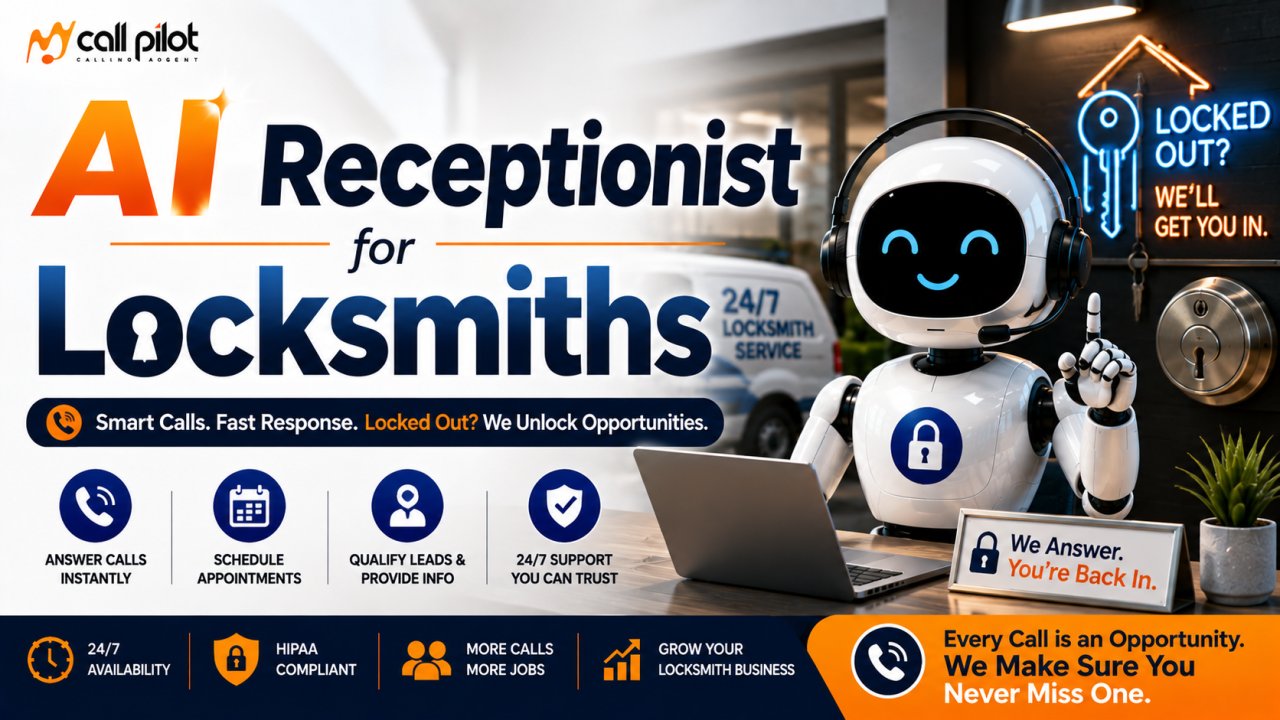
AI receptionist technology for locksmiths answers every incoming call the moment it rings, day or night, so a customer locked out of their car at 2 AM reaches a live voice instead of a ring that goes unanswered. For a locksmith business, the phone is not just a lead source the way it is for most trades. It is the entire business model. A missed call is not a missed opportunity that might come back around. It is a customer who is already dialing the next listing before your voicemail greeting finishes.
My Call Pilot runs this as one platform, answering inbound emergency and scheduling calls, following up automatically on missed calls or old leads through outbound campaigns and capturing website visitors who would rather type than call, all from a single setup and a single pool of minutes.
What Is an AI Receptionist for Locksmiths
An AI receptionist for locksmiths is a conversational AI system trained to answer incoming calls to a locksmith business, gather the details a technician needs and either book the job or dispatch it, without a human sitting by the phone.
For most industries that description would be enough. Locksmithing adds two requirements that a generic receptionist script does not cover. First, the AI needs to quickly tell an emergency lockout from a routine call, since a car lockout at midnight and a request to quote a commercial rekey next month need completely different handling speeds. Second, because so much of the industry's call volume is fielded by lead generation call centers rather than the actual local shop, an AI receptionist that clearly represents a real, identifiable local business becomes a trust signal in a way it simply is not for most other trades.
Why Locksmiths in Particular Need This
A caller locked out of their car does not wait patiently. Industry data consistently shows the average caller in this situation will abandon a ringing call in well under a minute and once a voicemail box picks up, the overwhelming majority never leave a message at all, they simply call the next locksmith on the search results page. That single behavior pattern is the reason phone answering matters more for locksmiths than for almost any other home service trade.
The scale of the miss is not small. One 2026 industry review of over 240 locksmith shops put the median inbound call miss rate at roughly one in three calls, while a separate industry analysis of locksmith call handling put the figure closer to one in four. Sources do not fully agree on the exact percentage and any specific number you read online should be treated as an estimate rather than a fact about your own shop. What both figures agree on is the direction. A meaningful share of locksmith calls, commonly cited in the range of 23% to 34%, go unanswered and after hours calls make up a large share of that volume, with one industry report placing after hours call share at roughly 39% of total volume.
Each of those missed calls carries real weight. Industry estimates place the average revenue tied to a single emergency lockout call at around $185, climbing higher once follow on work like a lock replacement or a rekey is factored in. A shop missing even a handful of emergency calls a week is not looking at a minor inefficiency. It is looking at a recurring five figure gap over the course of a year.
How an AI Receptionist Handles a Real Lockout Call
- The call is answered immediately, with no ring delay and no hold music, since a caller standing outside a locked car will hang up within seconds if nothing happens.
- The AI asks the two questions that actually matter first, where the caller is located and whether this is an emergency, so a stranded caller is routed differently than someone requesting a quote for next week.
- For emergency calls, it collects what a technician needs on the way, an address or cross streets, whether it is a home, vehicle or business lockout and any access complications like a gated lot or apartment building.
- It dispatches the job to the right technician, typically by text message, while the caller stays on the line hearing that help is on the way rather than being put on hold.
- For non emergency calls, it can quote a starting price range, check availability and book the appointment directly, the same way it would for any scheduled service call.
- Every call produces a transcript and summary, so the shop owner can review what was promised to a customer without relying on memory.
What It Can Handle Well and Where a Human Still Matters
An AI receptionist for locksmiths is generally strong at answering instantly around the clock, telling emergency calls apart from routine ones, collecting dispatch ready details, quoting a starting price range and booking scheduled work onto a calendar.
It is not a substitute for a technician's on site judgment about a specific lock and it should never be the one deciding whether a job requires drilling or a full lock replacement. That assessment happens in person, not on the phone. A properly configured AI receptionist sticks to intake and dispatch and leaves the technical diagnosis to the technician who actually shows up.
The Trust Problem This Solves That Other Trades Do Not Have
Locksmithing carries a scam problem that most trades simply do not deal with at this scale. State consumer protection agencies and the FTC have warned for years about a bait and switch pattern in this exact industry, where a caller is quoted a low price by phone, often by an out of state call center rather than the actual local business, only to be told on site that the job is more complicated and the price is now several times higher. Licensing requirements also vary sharply by state, with some states requiring locksmiths to be individually licensed and others requiring none at all, which means a caller often has no easy way to tell a legitimate local shop from a lead generation operation on the first ring.
This is where a well built AI receptionist becomes more than a convenience. Because it answers using your business's real information rather than a generic script, it can state your actual local service area, your starting price range and your license number if applicable, immediately, on the first call, before a caller ever has reason to wonder who they are really talking to. A national dispatch operation routing calls to unverified subcontractors cannot easily replicate that. A single local shop with a properly configured AI receptionist can.
AI Receptionist vs the Alternatives for a Locksmith Business
| Factor | AI Receptionist | Voicemail | Shared Answering Service | Owner Answering Personally |
|---|---|---|---|---|
| Availability | Answers 24 hours a day, every day | Available around the clock but resolves nothing | Usually available around the clock | Limited to whenever they are free, which during a job is effectively never |
| Emergency call handling | Immediately separates an emergency from a routine call and collects dispatch details on the spot | Cannot act on anything, only records a message the caller will likely never leave | Can qualify a call but is often unfamiliar with your specific pricing and service area | Accurate but only when physically able to pick up |
| Represents your actual business | Built on your business information, states your real service area and pricing | Neutral either way | May sound generic rather than specific to your shop, since it often serves multiple locksmith clients | Naturally authentic but not always available |
| Cost pattern | Runs on a monthly plan that scales with call volume | Essentially free but produces almost no conversions given how few callers leave a message | Typically billed per minute or per call, which adds up quickly during a busy emergency stretch | Costs nothing in cash but costs time that could otherwise go toward paying jobs |
What It Costs
Locksmith specific answering solutions across the market in 2026 range widely, from AI only options priced as low as roughly $40 a month with flat unlimited call handling, up through shared human answering services that typically run several hundred dollars a month once per minute or per call charges are included. As with any home service business, the pricing model matters more than the sticker price. A cheap per minute plan can become expensive fast during a busy holiday weekend, while a flat monthly rate stays predictable no matter how many lockout calls come in during a single overnight shift.
For My Call Pilot's specific current pricing, check the pricing page directly rather than relying on a number quoted here, since plans and minute allowances change over time.
How to Estimate Your Own Return
Start with your own numbers rather than a generic industry multiplier. Count how many calls you currently miss in an average week, whether from a busy signal, a call arriving while a technician is on another job or simple after hours timing. Multiply that by a realistic estimate of what an average job is worth to your shop, factoring in that a portion of missed calls would not have converted even if answered. The result is a rough monthly opportunity number you can compare against the monthly cost of an AI receptionist.
As one industry example, a shop missing even three or four overnight emergency calls a week, at an average ticket in the range commonly cited for lockout work, can be looking at well over a thousand dollars a month in calls that were never answered at all. Your own numbers will differ based on your market and your current call volume, which is exactly why running this calculation yourself matters more than trusting someone else's percentage.
Common Objections Answered Honestly
Will customers trust an AI answering the phone during an emergency
Often yes, particularly once the AI immediately confirms it understood the situation and states that help is being dispatched. What matters most to a stressed caller is speed and clarity, not necessarily who or what answered.
Can it actually tell a real emergency from someone just asking about pricing
A properly configured AI receptionist asks directly whether the situation is urgent and routes accordingly, the same way a trained human dispatcher would.
What if the caller describes a lock the AI does not recognize
It should collect what it can and pass the details to a technician rather than guessing at a diagnosis, since lock assessment is a job for someone standing in front of the door, not for a phone call.
Will this replace my need for a dispatcher or a second employee
For most one to three technician shops, it replaces the coverage gap, meaning nights, weekends and moments when every technician is already on a job, rather than replacing a role you already have staffed.
Is it hard to set up for a business that runs on mobile dispatch rather than a storefront
Setup involves loading in your service area, starting price ranges and how you want jobs routed to technicians, which takes real configuration time but does not require a fixed location the way some traditional phone systems do.
Who This Is Actually For
Locksmith businesses that take a meaningful share of calls outside a fixed nine to five schedule, run one or more mobile technicians rather than a single storefront desk and rely on the phone as the primary way new customers reach them, tend to see the clearest case for an AI receptionist. A shop that does almost all of its business through pre scheduled commercial contracts with very little emergency call volume may see less benefit from the emergency routing features specifically, though the scheduling and after hours coverage still apply.
Seven Questions to Ask Before Choosing One
- Does it ask the right two questions immediately, where the caller is and whether it is an emergency, or does it just take a generic message
- Can it state your actual price range and service area on the call, or does it sound like a generic national script
- How does it hand a job to a technician, by text, by call or through a dispatch tool you already use
- What happens if a caller describes something the AI cannot confidently handle, does it escalate cleanly to a human line
- Is pricing flat and predictable, or will a busy overnight push your bill up through per minute charges
- Can you review the transcript of exactly what was quoted to a customer if a dispute comes up later
- How long does setup actually take once your real pricing and service area are loaded in
Why Businesses Choose My Call Pilot
My Call Pilot runs as one conversational AI platform rather than a stack of separate tools, covering inbound call answering, outbound follow up campaigns for missed calls or old leads and a website widget for visitors who would rather message than call, all sharing a single setup of your business information and a single pool of minutes. The most reliable way to judge whether it fits a locksmith business specifically is to run a live test call using a real lockout scenario and see how it handles the two questions that matter most, location and urgency.
Start Exploring AI Phone Automation for Locksmiths
Frequently Asked Questions
What is an AI receptionist for locksmiths
It is a conversational AI system that answers incoming calls to a locksmith business, tells emergency lockouts apart from routine requests, collects dispatch ready details and either books the job or sends it straight to a technician, all without a human personally answering the phone.
How much does an AI receptionist for locksmiths cost
Locksmith focused AI answering options in 2026 start around $40 a month for flat rate unlimited plans, while shared human answering services commonly run several hundred dollars a month once per minute or per call charges are added in.
Is it worth it for a small one or two technician locksmith shop
For shops that take a meaningful share of emergency or after hours calls, it often is, since a single missed lockout call can represent close to two hundred dollars in lost revenue and callers rarely leave a voicemail or call back.
Can it tell the difference between an emergency lockout and a routine scheduling call
Yes, when configured correctly it asks directly whether the situation is urgent and routes the call accordingly, similar to how a trained human dispatcher would handle the same question.
Does using an AI receptionist help with the locksmith scam trust problem
It can, because an AI receptionist built on your real business information states your actual local service area and pricing immediately, which is exactly the information a bait and switch call center cannot easily provide.
Will it replace my technicians or a dispatcher
For most small shops it fills the coverage gap during nights, weekends and moments when every technician is already on a job, rather than replacing an existing employee.
See It Handle a Real Lockout Call
The clearest way to judge whether an AI receptionist fits a locksmith business is to hear it handle an actual emergency scenario, not just read about it.