On this page (73)
- See How My Call Pilot Works
- Your Restaurant Phone Should Not Compete With Your Dining Room
- What Is an AI Receptionist for Restaurants?
- Why Restaurants Are Different
- The Restaurant Call Flow Framework
- 1 Answer
- 2 Understand
- 3 Resolve
- 4 Book or Capture
- 5 Confirm
- What Can an AI Receptionist Handle for a Restaurant?
- Restaurant Reservations
- Takeaway Orders
- Menu Questions
- Dietary and Allergen Questions
- Catering Inquiries
- Large Group Reservations
- After Hours Calls
- Peak Hour Call Handling
- AI Receptionist vs Voicemail
- AI Receptionist vs Human Restaurant Staff
- AI Receptionist vs Restaurant Answering Service
- How Much Does an AI Receptionist for Restaurants Cost?
- Look Beyond the Monthly Price
- How to Calculate Restaurant AI Receptionist ROI
- What Should an AI Receptionist Know About Your Restaurant?
- Restaurant Information
- Menu Information
- Reservation Information
- Ordering Information
- Escalation Rules
- What Should a Restaurant AI Receptionist Never Do?
- What to Look For Before Choosing an AI Receptionist
- Can It Handle Restaurant Conversations?
- Can It Handle Reservations?
- Can It Handle Orders?
- Does It Connect With Your POS?
- Can It Handle Multiple Calls?
- What Happens When AI Cannot Help?
- Can You Update Menu Information?
- Can You Review Conversations?
- How Is Pricing Calculated?
- Questions Restaurant Owners Should Ask Before Buying
- 1 Can the AI handle my actual menu?
- 2 Can it understand modifications?
- 3 Can it answer allergen questions safely?
- 4 Can it book real reservations?
- 5 Can it send orders into my POS?
- 6 What happens during a call surge?
- 7 Can I transfer the caller to staff?
- 8 What happens if the AI misunderstands?
- 9 What happens when the restaurant is closed?
- 10 What will I actually pay each month?
- When Is an AI Receptionist a Good Fit for a Restaurant?
- When AI May Not Be the Right Choice
- The Most Important Difference Between Restaurant AI Systems
- Why My Call Pilot
- Give Your Restaurant Phone a Better Workflow
- Explore My Call Pilot
- Frequently Asked Questions
- What is an AI receptionist for restaurants?
- Can an AI receptionist take restaurant orders?
- Can an AI receptionist make restaurant reservations?
- Can an AI receptionist answer restaurant calls after hours?
- Can an AI receptionist answer questions about my menu?
- Can AI handle restaurant allergen questions?
- How much does an AI receptionist for restaurants cost?
- Is an AI receptionist better than a human answering service?
- Can an AI receptionist replace restaurant staff?
- Can an AI receptionist handle busy dinner rushes?
- Can an AI receptionist handle catering inquiries?
- What should I look for in an AI receptionist for my restaurant?
- Turn More Restaurant Calls Into Useful Conversations
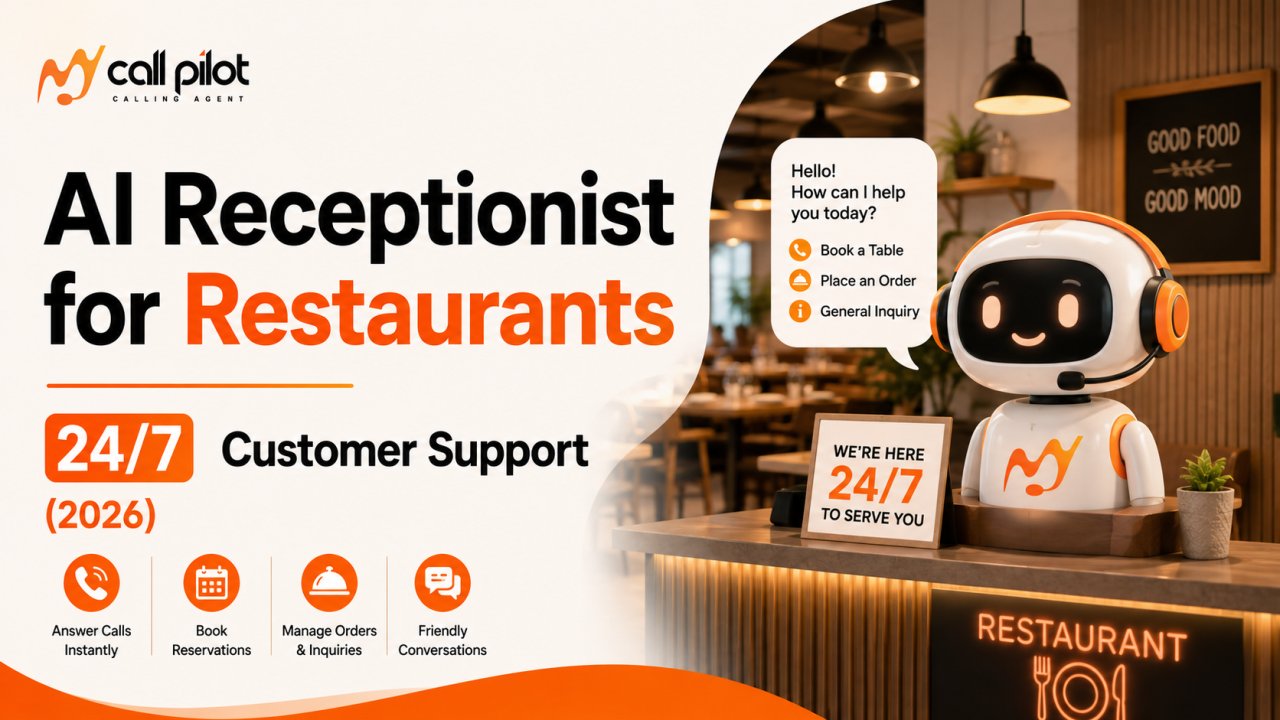
AI Receptionist for Restaurants helps restaurants handle incoming calls when your team is busy serving guests, taking orders, managing tables or working through the dinner rush.
Your restaurant may have excellent food, great reviews and a strong location.
But none of that helps when a customer calls and nobody can answer.
A guest may want to book a table.
Another caller may want to place a takeaway order.
Someone else may be asking whether you have outdoor seating, whether a menu item contains a particular ingredient or whether you can accommodate a large group.
Your staff cannot always stop what they are doing to answer every call.
An AI receptionist gives your restaurant another way to handle those conversations.
See How My Call Pilot Works
Your Restaurant Phone Should Not Compete With Your Dining Room
Restaurant phone calls often arrive at the worst possible time.
The host is seating a table.
A server is carrying food.
The manager is dealing with a customer.
The kitchen is handling a rush.
Then the phone rings.
If nobody answers, the caller may hang up.
They may call again.
Or they may simply choose another restaurant.
Current restaurant AI platforms are increasingly designed around exactly these problems, including reservations, phone orders, guest questions and peak hour call handling.
The important question is not whether your restaurant receives calls.
It is whether your team can consistently handle those calls while taking care of the guests already inside your restaurant.
What Is an AI Receptionist for Restaurants?
An AI receptionist for restaurants is an AI powered voice system that can answer restaurant phone calls and follow a configured conversation workflow.
Depending on the system and its configuration it may help with
Reservations
Takeaway inquiries
Food orders
Menu questions
Opening hours
Location questions
Catering inquiries
Large group requests
Existing reservation questions
After hours calls
General customer questions
The key difference between an AI receptionist and voicemail is conversation.
Voicemail asks the caller to leave a message.
An AI receptionist can interact with the caller and guide the conversation toward the appropriate next step.
Why Restaurants Are Different
A restaurant phone is not simply a business phone.
It is often connected directly to revenue.
A caller may be trying to
Reserve a table
Place an order
Ask about a menu item
Ask about allergens
Check opening hours
Ask about delivery
Ask about takeaway
Book a private event
Arrange catering
Modify a reservation
Ask about parking
Ask about accessibility
Speak with a manager
That means the receptionist needs to understand the context of restaurant conversations.
A generic phone answering system may not be enough.
The workflow needs to reflect how your restaurant actually operates.
The Restaurant Call Flow Framework
A useful restaurant AI receptionist can be evaluated through five stages.
1 Answer
The system responds to the incoming call so the customer is not immediately sent to voicemail.
This is especially useful during busy dining periods when employees may not be able to reach the phone.
2 Understand
The AI determines what the guest needs.
For example
Reservation
Food order
Menu question
Catering inquiry
Large party
Existing booking
Opening hours
General question
Understanding the reason for the call is the foundation of a useful conversation.
3 Resolve
If the question is covered by the restaurant's approved information the AI can provide the appropriate response.
This might include information about
Opening hours
Location
Menu
Dining options
Reservation policies
Takeaway
Delivery
Parking
Common guest questions
The information must come from accurate restaurant data.
Incorrect menu information can be worse than no answer.
4 Book or Capture
Depending on the configured capabilities the system may help move the caller toward the appropriate action.
That could mean
Supporting a reservation workflow
Capturing a catering inquiry
Supporting an order
Collecting customer details
Routing the caller to staff
The exact capabilities depend on the platform and configuration.
5 Confirm
The final step should make the next action clear.
For example
Reservation confirmed
Request captured
Order information confirmed
Call transferred
Staff callback required
Further action needed
The goal is to prevent the caller from wondering what happens next.
What Can an AI Receptionist Handle for a Restaurant?
The answer depends on the system you choose and how it is configured.
However, restaurant specific AI solutions commonly focus on several important workflows.
Restaurant Reservations
Reservations are one of the most obvious use cases.
A caller may want to know
Is there a table available tonight?
Can I book for four people?
Do you accept large groups?
Can I request outdoor seating?
Can I change my reservation?
What time does the kitchen close?
A configured AI receptionist can support these conversations when the required reservation system and workflow are available.
Current restaurant AI services commonly market reservation handling as a core feature.
The important thing is to verify whether the provider actually connects to the reservation platform your restaurant uses.
Do not assume that a provider saying it supports reservations means it supports your specific reservation system.
Takeaway Orders
Phone orders can become difficult during peak periods.
A restaurant employee may need to answer the phone while also serving guests.
A capable restaurant AI system may support order conversations depending on its configuration and integrations.
The workflow can potentially include
Customer name
Order items
Quantity
Modifications
Special requests
Pickup information
Delivery information
Order confirmation
Some restaurant AI providers now advertise direct connections with POS and ordering systems.
This is an area where verification matters.
Before choosing a platform confirm whether orders are actually sent into your POS or whether the system simply records the information elsewhere.
Menu Questions
Customers frequently call with simple questions.
They may ask
Do you serve vegetarian food?
Do you have gluten free options?
What comes with this meal?
Can I remove an ingredient?
Do you have kids meals?
Do you serve desserts?
What drinks do you offer?
What are today's specials?
An AI receptionist can answer these questions when it has access to an accurate and properly configured restaurant knowledge base.
The restaurant should regularly review the information.
If an item is removed from the menu the AI should not continue telling customers that it is available.
Dietary and Allergen Questions
This area requires additional care.
Customers may ask about
Gluten
Dairy
Nuts
Eggs
Vegetarian options
Vegan options
Other dietary requirements
An AI system should only provide information that the restaurant has explicitly approved.
It should not guess about allergens.
If the information is uncertain the safer workflow is to involve a member of staff.
Catering Inquiries
Restaurants often receive calls about
Corporate catering
Birthday parties
Weddings
Private events
Office lunches
Large orders
Group dining
These calls can require more information than a standard takeaway order.
An AI receptionist can potentially collect the initial details and route the inquiry according to the restaurant's workflow.
Useful information may include
Customer name
Phone number
Event date
Number of guests
Event type
Food requirements
Preferred service
Budget range
Location
Callback preference
This gives your team a structured starting point.
Large Group Reservations
A large party can be valuable but may also require special handling.
The restaurant may have specific rules for
Minimum spend
Deposit
Set menus
Seating arrangements
Private rooms
Cancellation policies
Maximum party size
An AI receptionist should follow those rules rather than inventing answers.
If a request falls outside the approved workflow the caller should be routed to staff.
After Hours Calls
Customers do not always call during restaurant opening hours.
They may call late at night to ask about
Tomorrow's reservations
Catering
Private events
Opening times
Menu information
Future bookings
An AI receptionist can provide an additional layer of coverage when your staff are no longer available, depending on configuration.
This can be especially useful for restaurants that receive significant call volume outside their main service periods.
Peak Hour Call Handling
This may be one of the strongest use cases.
Imagine your restaurant at 7 PM on Friday.
The dining room is full.
The host is seating guests.
The kitchen is busy.
The phone rings.
Then it rings again.
Then another call arrives.
Your staff cannot stop everything to answer three calls at once.
An AI receptionist can provide another layer of call handling during these periods when configured to do so.
The objective is simple.
Keep the phone from becoming another source of pressure for your team.
AI Receptionist vs Voicemail
Voicemail is useful for taking messages.
But it does not have a conversation with the caller.
| Capability | Voicemail | AI Receptionist |
|---|---|---|
| Answers automatically | Yes | Yes |
| Holds a conversation | No | Yes |
| Handles common questions | No | Depending on configuration |
| Supports reservations | No | Depending on configuration |
| Supports order workflows | No | Depending on configuration |
| Collects structured information | Limited | Yes depending on configuration |
| After hours coverage | Yes | Yes |
| Peak hour support | Limited | Yes |
| Human escalation | Callback required | Depending on configuration |
For a restaurant the difference can be meaningful.
A customer who calls about a reservation may not want to leave a message and wait.
They may simply call another restaurant.
AI Receptionist vs Human Restaurant Staff
AI does not need to replace your restaurant employees.
A better approach is often to let AI handle predictable conversations while people handle situations that require judgment, empathy or operational decision making.
| Area | Human Staff | AI Receptionist |
|---|---|---|
| Personal interaction | Strong | Limited |
| Peak call volume | Limited by staffing | Strong potential |
| Repetitive questions | Good | Strong fit |
| Complex customer situations | Strong | Should escalate |
| Menu information | Strong | Strong when configured correctly |
| Reservations | Strong | Possible depending on setup |
| Order handling | Strong | Possible depending on setup |
| After hours | Requires staffing | Strong potential |
| Judgment | Strong | Limited |
| Consistency | Depends on staff | Consistent configured workflow |
The best model may be a combination.
AI handles what it can.
People handle what requires people.
AI Receptionist vs Restaurant Answering Service
A traditional answering service can provide human operators who answer calls on behalf of the restaurant.
An AI receptionist uses automated voice interaction.
Both have advantages.
| Factor | Human Answering Service | AI Receptionist |
|---|---|---|
| Human conversation | Yes | No or limited escalation |
| Automated availability | Depends on service | Common |
| Peak volume | Staffing dependent | Software dependent |
| Repetitive questions | Good | Strong fit |
| Restaurant specific knowledge | Depends on training | Configuration dependent |
| Reservation support | Provider dependent | Provider dependent |
| Order support | Provider dependent | Provider dependent |
| Cost scalability | Often usage based | Often subscription or usage based |
| Complex situations | Strong | Human escalation recommended |
There is no universal winner.
A restaurant should choose based on call volume, complexity, customer expectations, staff availability and the workflow it wants to automate.
How Much Does an AI Receptionist for Restaurants Cost?
Restaurant AI receptionist pricing varies widely.
Current pricing examples show plans ranging from low cost monthly subscriptions to several hundred dollars per restaurant location. Some providers advertise prices around $29 per month while restaurant focused systems can reach $399 or more per location.
Pricing can depend on
Monthly call minutes
Number of locations
Number of calls
Concurrent calls
Reservation functionality
Order handling
POS integrations
SMS
Languages
Custom workflows
Setup
Support
Usage limits
Look Beyond the Monthly Price
A low monthly price does not necessarily mean a better deal.
Ask what is included.
For example
How many minutes are included?
Are there overage charges?
Does the system support restaurant orders?
Does it connect to your POS?
Does it connect to your reservation platform?
Can it handle multiple calls?
Can it transfer complex calls to staff?
The actual cost should be calculated using your restaurant's expected call volume.
How to Calculate Restaurant AI Receptionist ROI
A simple ROI framework starts with your existing calls.
Monthly restaurant calls
Calls that go unanswered
Potential reservations and orders
Potential customers recovered
Average value per reservation or order
Potential opportunity value
AI receptionist cost
Do not assume that every missed call represents a lost customer.
Instead review your call data.
Find out
How many calls are missed
When those calls occur
How many are reservations
How many are orders
How many are general questions
How many are existing customers
How many are spam
How many are genuine sales opportunities
This gives you a much more realistic picture of potential value.
What Should an AI Receptionist Know About Your Restaurant?
A useful restaurant AI receptionist needs accurate information.
This can include
Restaurant Information
Restaurant name
Address
Opening hours
Holiday hours
Contact information
Parking information
Accessibility information
Menu Information
Food items
Prices
Ingredients
Modifications
Dietary information
Drinks
Desserts
Specials
Reservation Information
Reservation hours
Party size rules
Cancellation policy
Deposit policy
Large group policy
Seating options
Ordering Information
Pickup
Delivery
Order minimums
Payment methods
Estimated preparation times
Ordering restrictions
Escalation Rules
When to transfer
Who receives the call
Which issues require a manager
Which questions the AI should not answer
The better the information the more useful the conversation can become.
What Should a Restaurant AI Receptionist Never Do?
There should be clear boundaries.
An AI receptionist should not
Guess menu prices
Invent unavailable dishes
Guess about allergens
Promise a table without confirmed availability
Promise an order time without approved information
Invent discounts
Make unauthorized refunds
Make operational decisions
Provide unsupported information
Pretend a human is speaking when disclosure is required
Continue a conversation that clearly requires human judgment
Restaurant automation should improve the customer experience.
It should not create new problems for the team.
What to Look For Before Choosing an AI Receptionist
Can It Handle Restaurant Conversations?
Ask whether the platform is designed for restaurant workflows or simply adapted from a generic business receptionist.
Can It Handle Reservations?
If reservations are important to your business verify the exact reservation platform supported.
Do not accept a vague claim that the system supports bookings.
Can It Handle Orders?
If phone ordering matters ask whether the system can actually take complete orders including modifications.
Does It Connect With Your POS?
This is one of the most important questions for restaurants.
A system that simply writes down an order is different from a system that sends the order into your actual POS workflow.
Verify the exact platform.
Can It Handle Multiple Calls?
Peak dining periods can create several simultaneous calls.
Ask how many calls the system can handle at once and what happens when capacity is reached.
What Happens When AI Cannot Help?
There should be a clear escalation path.
The system should know when to stop and involve a human.
Can You Update Menu Information?
Menus change.
Prices change.
Specials change.
Opening hours change.
Ask how easily your team can update restaurant information.
Can You Review Conversations?
Call analytics, transcripts, recordings or summaries can help identify problems and improve the workflow.
Availability depends on the provider.
How Is Pricing Calculated?
Understand
Monthly subscription
Included minutes
Extra usage
Setup fees
Location fees
Integration fees
Additional numbers
Cancellation terms
Questions Restaurant Owners Should Ask Before Buying
Before choosing a provider ask these questions.
1 Can the AI handle my actual menu?
A demo menu is not enough.
Test your real menu.
2 Can it understand modifications?
Try realistic requests.
For example
A customer wants to remove an ingredient.
A customer wants to substitute a side.
A customer wants multiple modifications.
See how the system responds.
3 Can it answer allergen questions safely?
Ask how the system handles uncertainty.
4 Can it book real reservations?
Verify whether it actually connects to your reservation system.
5 Can it send orders into my POS?
Ask for the exact integration.
6 What happens during a call surge?
A Friday evening is different from a Tuesday afternoon.
7 Can I transfer the caller to staff?
Human escalation can be critical.
8 What happens if the AI misunderstands?
Ask about fallback workflows.
9 What happens when the restaurant is closed?
Verify the exact after hours behavior.
10 What will I actually pay each month?
Calculate the total cost based on your expected usage.
When Is an AI Receptionist a Good Fit for a Restaurant?
It may be worth considering if
Your phone frequently rings during service
Staff regularly miss calls
Customers leave messages that are never followed up quickly
You receive many reservation calls
You receive phone orders
Your team answers repetitive questions
You receive after hours inquiries
Your restaurant experiences seasonal demand
You operate multiple locations
Your managers spend too much time handling routine calls
You want a more consistent phone experience
When AI May Not Be the Right Choice
AI is not automatically right for every restaurant.
You may want another solution if
Your call volume is extremely low
Nearly every call requires human judgment
Your restaurant has a highly personal reservation process
Your existing team already answers virtually every call
Your customers strongly prefer human interaction
Your phone workflow is too complex to automate safely
The goal is not to automate everything.
The goal is to automate the right things.
The Most Important Difference Between Restaurant AI Systems
Do not compare restaurant AI platforms only by asking
Does it answer the phone?
Almost every solution in this category can make that claim.
Instead ask
What can it actually complete during the call?
There is a major difference between a system that
Answers and takes a message
and one that
Answers, understands, handles, books or captures and confirms
That difference should influence your buying decision far more than the word AI on the pricing page.
Why My Call Pilot
The right restaurant phone solution should fit the way your restaurant operates.
That means considering
Your menu
Your reservation process
Your ordering workflow
Your business hours
Your peak periods
Your customer questions
Your staff availability
Your escalation process
Your existing technology
My Call Pilot can be evaluated as the platform for creating a more structured phone experience around your business.
Give Your Restaurant Phone a Better Workflow
Your staff should be focused on the people already inside your restaurant.
They should not have to choose between serving guests and answering another ringing phone.
An AI receptionist can provide another layer of coverage for reservations, customer questions, order inquiries, catering requests and after hours calls when configured for those workflows.
The goal is not to remove the human element from hospitality.
The goal is to make sure your team spends more time on the conversations that actually need them.
Explore My Call Pilot
Frequently Asked Questions
What is an AI receptionist for restaurants?
An AI receptionist for restaurants is an AI powered voice system that answers incoming restaurant calls and follows configured workflows. Depending on the platform it may handle reservations, order inquiries, menu questions, catering requests, opening hours and other common guest questions.
Can an AI receptionist take restaurant orders?
Some restaurant AI platforms support phone ordering, including menu items and modifications. However capabilities vary significantly between providers. Before purchasing verify whether the system can handle your actual menu and whether orders can be sent into your POS or ordering system.
Can an AI receptionist make restaurant reservations?
Yes, some AI receptionist systems support reservation workflows. The important consideration is whether the platform integrates with the reservation system your restaurant already uses. Reservation functionality should be verified rather than assumed.
Can an AI receptionist answer restaurant calls after hours?
Yes, after hours call handling is a common use case. Depending on configuration the AI may answer questions, capture requests, support reservations or route callers according to your restaurant's rules.
Can an AI receptionist answer questions about my menu?
It can answer menu questions when the relevant information has been accurately configured. Restaurant owners should regularly update menu information and ensure the AI does not guess about prices, ingredients, availability or allergens.
Can AI handle restaurant allergen questions?
AI can provide approved allergen information when the restaurant has supplied accurate data. However it should not guess about allergens. If information is uncertain the call should be escalated to an appropriate member of staff.
How much does an AI receptionist for restaurants cost?
Restaurant AI receptionist pricing varies by provider and features. Published examples range from roughly $29 per month to several hundred dollars per location. Pricing can depend on call volume, included minutes, reservations, ordering, integrations and support.
Is an AI receptionist better than a human answering service?
Neither option is automatically better. AI can provide scalable automated call handling while human answering services provide human interaction and judgment. Restaurants should compare their call volume, workflow complexity, customer expectations and budget.
Can an AI receptionist replace restaurant staff?
It can automate some phone tasks, but replacing staff should not necessarily be the objective. AI can handle repetitive conversations while employees focus on guests, complex requests, operational decisions and situations requiring human judgment.
Can an AI receptionist handle busy dinner rushes?
Peak hour coverage is one of the main reasons restaurants consider AI phone systems. The exact capacity depends on the provider. Ask how many simultaneous calls can be handled and what happens when the system reaches its capacity.
Can an AI receptionist handle catering inquiries?
Depending on the platform and configuration it can collect information such as event date, guest count, event type, contact information and requested services before passing the inquiry to the restaurant team.
What should I look for in an AI receptionist for my restaurant?
Focus on actual workflows rather than marketing claims. Verify reservation support, order handling, menu knowledge, POS connectivity, call capacity, human escalation, after hours behavior, analytics, pricing and the ability to update restaurant information.
Turn More Restaurant Calls Into Useful Conversations
Your restaurant cannot control when customers call.
You can control what happens when they do.
An AI receptionist can help your restaurant respond to calls during busy service periods, after hours and other situations when your team cannot reach the phone.
The strongest setup is not the one that tries to automate every conversation.
It is the one that knows what to answer, what to capture, what to book and when to involve a person.