On this page (22)
- See How My Call Pilot Handles Your Calls
- What Is an Automated Phone System?
- Two Very Different Kinds of "Automated Phone System"
- Why an Automated Phone System Matters
- How an AI Powered Automated Phone System Works
- Benefits of an Automated Phone System
- Who Uses an Automated Phone System
- Automated Phone System vs. the Alternatives
- When an Automated Phone System Is Not the Right Choice
- 7 Questions to Ask Before You Buy an Automated Phone System
- How to Estimate the Value of Fixing Your Missed Calls
- How Automated Phone Systems Are Typically Priced
- Common Objections, Answered
- Frequently Asked Questions
- What is an automated phone system?
- Is an automated phone system the same as an AI receptionist?
- How much does an automated phone system cost?
- Can an automated phone system book appointments?
- Do automated phone systems work after hours?
- Will an automated phone system replace my receptionist?
- How is My Call Pilot different from a basic auto attendant?
- Choosing an Automated Phone System
Automated phone system technology answers, routes and often resolves your business calls without a staff member picking up every ring. For a small business, that usually means the difference between a lead who reaches someone and a lead who hangs up and calls the next name on the list.
Every business with a phone number eventually hits the same wall. Call volume doesn't arrive on a schedule. It spikes when you're on a job site, in an exam room, in the middle of a showing, or closed for the night, exactly when no one is free to answer. An automated phone system exists to close that gap, so the business keeps functioning even when a human isn't available to pick up.
See How My Call Pilot Handles Your Calls
What Is an Automated Phone System?
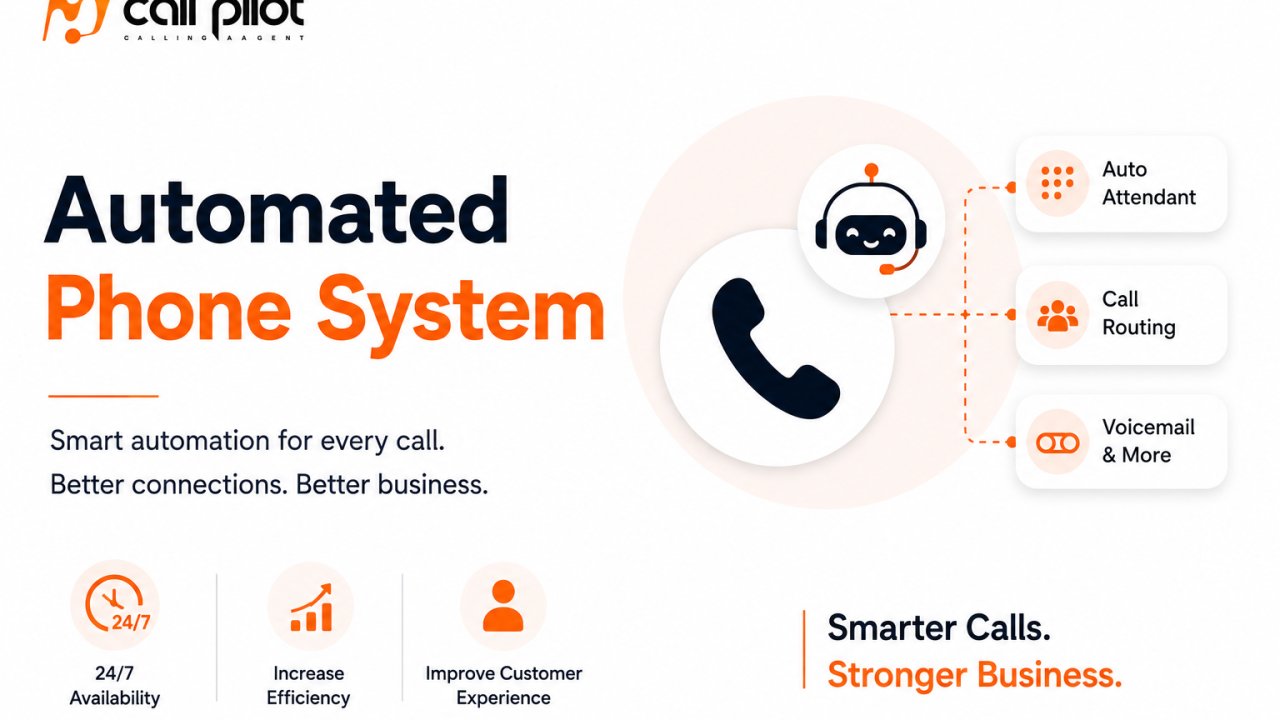
An automated phone system is software that answers, routes, or converses with incoming (and sometimes outgoing) business calls without requiring a live person on every call. Instead of a receptionist manually answering each line, the system greets the caller, figures out what they need and either resolves it directly, transfers them to the right person, or captures the details for follow up.
That definition covers a wide range of technology, from a simple, older menu system to a modern AI agent that carries on a full conversation. Understanding which kind you're evaluating matters more than most buying guides admit.
Two Very Different Kinds of "Automated Phone System"
This is the part most comparison articles skip past and it's the single most important thing to understand before you shop.
Rule based IVR / auto attendant. This is the classic "press 1 for sales, press 2 for support" system. It follows a fixed menu tree. It's cheap, predictable and fine for pure call routing. But it can't answer a question, can't understand a caller who says something the menu didn't anticipate and can't hold a conversation. Callers who don't fit the menu usually end up in voicemail, which is where most of them give up.
AI conversational automated phone system. This generation uses natural language voice AI to actually talk with the caller, understanding free form speech, answering questions, checking availability, booking an appointment, or collecting the right details before handing off to a human. It behaves less like a phone tree and more like a competent front desk employee who never has a bad day, never takes a lunch break and never leaves the phone unanswered.
| Rule Based IVR / Auto Attendant | AI Conversational System | |
|---|---|---|
| How it works | Fixed menu, keypad/voice commands | Natural conversation, understands free speech |
| Handles unexpected questions | No, routes to voicemail | Often yes, within its configured scope |
| Books appointments | Rarely, without added tools | Commonly, when connected to a calendar |
| Feels like talking to | A phone tree | A person at the front desk |
| Best for | Pure call routing at scale | Answering, qualifying and booking, not just routing |
Neither is universally better. A large call center routing thousands of calls to specific departments may still want a fast, predictable IVR layer. A small business trying to stop losing leads generally needs the second kind, because the problem isn't routing, it's that nobody's there to actually talk to the caller.
Why an Automated Phone System Matters
📞 62% of calls to small businesses go unanswered by a live person, according to a 2024 analysis of 85 businesses across 58 industries by 411 Locals, only 37.8% were answered live. Estimates vary by study and industry, but every dataset reviewed points the same direction, missed calls are the norm, not the exception, for busy small businesses.
📉 85% of callers who don't reach a business the first time won't call back, they call the next result instead. That's the real cost of a missed call, it's rarely a delayed sale, it's usually a lost one.
💰 Industry estimates for the annual revenue lost to missed calls at a typical small service business commonly cluster in the tens of thousands of dollars, with some analyses of high call volume trades putting it over $100,000 a year. These figures are vendor and industry estimates rather than a single authoritative government statistic and your own number depends heavily on your call volume and average customer value, see the ROI framework below to calculate your own instead of relying on an industry average.
📱 68% of consumers still say they prefer the phone over online booking for service related appointments, according to industry research on customer scheduling behavior. Chat widgets and online forms help, but they don't replace the phone, they work best alongside it.
The pattern across all of this data is clear. The phone is still where a large share of leads and repeat customers reach out first and every unanswered ring is a live opportunity, not a routine inconvenience.
How an AI Powered Automated Phone System Works
At a high level, an AI driven automated phone system like My Call Pilot brings together the pieces that used to require separate tools.
Inbound answering. Calls to your business number are answered automatically, in natural conversation, so callers get a real response instead of a menu or voicemail, any hour of the day.
Outbound calling campaigns. The same AI can also place calls out, confirming appointments, following up on leads, or running a defined campaign, rather than only reacting to inbound volume.
Website voice and chat widgets. The same conversational AI can be embedded directly on your website, so a visitor can start talking or chatting immediately instead of waiting for a callback.
One plan, managed by minutes. Usage across inbound answering, outbound calling and website widgets is tracked as minutes on a single plan, rather than requiring separate subscriptions for separate channels.
The practical effect is that instead of stitching together a phone answering service, a separate outbound dialer and a separate website chat tool, the call handling logic, how it talks, what it knows, how it escalates, lives in one place and works consistently across every channel a customer might use to reach you.
Configuration details like available integrations, supported languages and specific call flows vary by setup, so the right way to confirm exact capability for your business is to walk through your own use case directly rather than assume every feature applies out of the box.
Benefits of an Automated Phone System
- No more silent phones. Calls get answered on the first ring, including nights, weekends and busy periods when no one is free.
- Consistent first impression. Every caller gets the same professional greeting and handling, it doesn't depend on who happens to pick up or how their day is going.
- Lower cost than staffing a phone line. A dedicated receptionist role carries a full time salary, benefits, training and coverage gaps for sick days and vacation. An automated system doesn't need PTO.
- Faster response to leads. Speed matters. Research on sales response times has repeatedly shown that the odds of qualifying a lead drop sharply the longer they wait for a first response. An automated system responds instantly, every time.
- One system across channels. Inbound calls, outbound follow up and website inquiries can be handled with the same underlying AI instead of three disconnected tools.
- Scales without hiring. Call volume spikes, seasonal, promotional, or just a busy week, don't require scrambling to add staff.
Who Uses an Automated Phone System
Automated phone systems show up most often in businesses where the phone is a primary channel for new business or scheduling and where staff are frequently unavailable to answer live.
- Home services (HVAC, plumbing, electrical, contractors), high after hours and emergency call volume
- Dental and healthcare practices, high call volume for scheduling, confirmations and general questions
- Real estate, inbound inquiries on listings that need an immediate response
- Legal, intake calls where a missed call is a missed client
- Hospitality and local retail, reservation and availability questions outside staffed hours
- Professional services and B2B, routing and qualifying inbound inquiries before they reach a person
Not every industry needs the same depth of automation. A business with low call volume and mostly scheduled interactions may get by with a simpler auto attendant, while high volume, high urgency call flow is where AI conversational systems earn their cost fastest.
Automated Phone System vs. the Alternatives
| Human Receptionist | Basic IVR / Auto Attendant | AI Conversational Automated Phone System | |
|---|---|---|---|
| Availability | Business hours only (typically) | 24/7, but menu limited | 24/7, full conversation |
| Handles novel questions | Yes | No | Often, within configured scope |
| Books appointments | Yes, manually | Rarely | Commonly, when connected to a calendar |
| Relative cost | Highest (salary + benefits) | Low | Low to moderate, usage based |
| Consistency | Varies by person, day, mood | Consistent but rigid | Consistent and conversational |
When an Automated Phone System Is Not the Right Choice
Not every business needs one and it's worth being honest about that before you buy anything.
- Very low call volume. If you get a handful of calls a week and rarely miss one, the math on paying for automation may not pencil out yet.
- Calls that are almost always highly complex or emotionally sensitive. Some intake conversations, certain legal, medical, or crisis situations, may be better handled by a trained human first, with automation used only for overflow or after hours triage.
- No clear escalation path. An automated system is only as good as what happens when it hits the edge of what it can do. If there's no human backup for edge cases, callers with unusual needs can get stuck.
If any of those describe your business, that doesn't rule out automation entirely, it usually means starting with after hours or overflow coverage rather than replacing live answering altogether.
7 Questions to Ask Before You Buy an Automated Phone System
- Is this a menu based IVR or a conversational AI system? Ask the vendor directly, IVR, auto attendant and AI receptionist get used loosely in marketing copy.
- What happens when it doesn't know the answer? Every system hits its limits. Ask how it escalates, voicemail, live transfer, or a message to staff.
- Can it actually book or reschedule an appointment, or does it just take a message?
- Does it handle inbound only, or also outbound and website inquiries? Buying three separate tools for three channels adds cost and inconsistency.
- How is usage billed, per minute, per call, or a flat plan, and what happens if you go over?
- How long does setup actually take and does it require technical work on your end?
- Can you hear a live example call in your industry before committing, not just a demo script?
How to Estimate the Value of Fixing Your Missed Calls
You don't need an industry wide average. You need your own number. Here is a simple framework.
Calls received per month → Calls currently missed → Realistic % that were real leads → Your close rate on a reached lead → Average value of a converted customer → Estimated monthly opportunity lost
For example, a business receiving 200 calls a month with a 30% miss rate, a 50% chance a missed call was a genuine lead, a 25% close rate and a $400 average customer value is losing roughly 200 × 0.30 × 0.50 × 0.25 × $400 ≈ $3,000 a month in unrealized revenue from missed calls alone, before counting existing customers who couldn't get through. Run your own numbers with your actual call volume and close rate rather than relying on a generic industry figure, since those vary widely by business and can overstate or understate your real exposure.
This isn't a guarantee of recovered revenue, it's a way to see whether the problem is worth solving before you evaluate solutions.
How Automated Phone Systems Are Typically Priced
Pricing across the market generally falls into a few models. Flat monthly subscriptions with a set call or minute allowance, per minute usage billing, per call billing, or tiered plans that combine a base fee with overage charges are all common. Because pricing structures and rates vary significantly by vendor, feature set and call volume, the right way to evaluate cost isn't a single headline number, it's total cost at your expected volume, including any overage charges, not just the advertised starting price.
My Call Pilot manages usage as minutes across inbound answering, outbound campaigns and website widgets on a single plan, rather than billing each channel separately. Talk to the team directly for current plan details and a quote based on your expected volume.
Common Objections, Answered
"Will callers know it's AI?" Depending on configuration, most callers can tell they're speaking with an automated system on some calls, the more useful question is whether the call gets handled well, not whether it's disguised as human.
"Will it sound robotic?" Voice quality varies significantly by provider and has improved substantially in recent years. Ask to hear a live call example in your industry before deciding, rather than judging from a generic demo.
"What if it doesn't know the answer?" A well configured system escalates, to voicemail, a live transfer, or a flagged message for staff, rather than leaving the caller stuck. Confirm exactly how escalation works before you commit.
"Can I still have a human answer sometimes?" Most setups support this. Automation is commonly used for after hours, overflow, or specific call types, with staff still handling calls directly when they're available, depending on how the system is configured.
"Is it expensive?" Compared to a full time receptionist's salary and benefits, most automated systems cost meaningfully less. But the right comparison is the system's cost against the revenue currently lost to missed calls, not against doing nothing.
"Will it replace my staff?" For most small businesses, the goal is closing the gap when staff aren't available, nights, job sites, busy periods, not replacing the team.
Frequently Asked Questions
What is an automated phone system?
Software that answers, routes, or converses with business calls without requiring a live person on every call, ranging from simple menu based IVR systems to AI conversational systems that can hold a real dialogue.
Is an automated phone system the same as an AI receptionist?
Not exactly. "Automated phone system" is the broader category, covering both traditional IVR and modern AI. An AI receptionist is a specific type of automated phone system that handles calls conversationally rather than through a fixed menu.
How much does an automated phone system cost?
Pricing varies by vendor and model, flat subscription, per minute, or per call, so the meaningful comparison is total monthly cost at your expected call volume, not the lowest advertised starting price.
Can an automated phone system book appointments?
AI conversational systems commonly can, when connected to a calendar; basic IVR systems generally cannot without additional tools.
Do automated phone systems work after hours?
Yes, 24/7 availability is one of the main reasons businesses adopt them, particularly for after hours and emergency call volume.
Will an automated phone system replace my receptionist?
For most small businesses it's used to cover the hours and call volume a live team can't, not to eliminate live staff.
How is My Call Pilot different from a basic auto attendant?
My Call Pilot uses conversational AI rather than a fixed menu tree and covers inbound answering, outbound calling and website voice or chat widgets on one platform with usage managed as minutes on a single plan.
Choosing an Automated Phone System
If your business is losing calls to job sites, exam rooms, closed hours, or busy front desks, the fastest way to know if this is worth solving is to run the estimate above against your own call volume, not to compare vendor feature lists first. Once you know roughly what missed calls are costing you, evaluating a system against the 7 questions above will tell you quickly whether it actually solves your problem.
My Call Pilot brings inbound answering, outbound calling and website voice and chat widgets together on one platform, so your call handling works the same way no matter how a customer reaches you.
Explore Automated Phone System Solutions | See How My Call Pilot Can Handle Your Business Calls