On this page (64)
- What Is an AI Receptionist for a Veterinary Clinic
- Why Veterinary Clinics Need Better Phone Coverage
- A missed call can create several problems
- What Can an AI Receptionist Do for a Veterinary Clinic
- Answer Common Questions
- Capture New Client Information
- Support Appointment Requests
- Handle Rescheduling and Cancellation Requests
- Support After Hours Calls
- Emergency Calls Require Special Care
- The principle is simple
- AI Receptionist vs Traditional Veterinary Receptionist
- AI Receptionist vs Voicemail
- A Better Veterinary Call Workflow
- New Client
- Existing Client
- Appointment Request
- Routine Question
- Urgent Concern
- Human Request
- What Should Your AI Receptionist Know About Your Clinic
- How AI Can Reduce Front Desk Pressure
- Which Veterinary Clinics Can Benefit
- General Veterinary Practices
- Animal Hospitals
- Specialty Veterinary Practices
- Multi Location Veterinary Groups
- Small Veterinary Practices
- High Volume Clinics
- When an AI Receptionist Is Not the Right Choice
- Can AI handle this call
- Should AI handle this call
- How Much Does a Veterinary AI Receptionist Cost
- How to Calculate the Business Value
- Monthly incoming calls
- Calls currently missed
- Potential new client opportunities
- Appointments generated
- Average value of an acquired client
- 10 Questions to Ask Before Choosing an AI Receptionist
- Can it understand veterinary terminology
- Can it follow our emergency instructions
- Can callers reach a person
- Can it schedule appointments
- Does it integrate with our practice management system
- Can we control its answers
- What happens when it does not know something
- Can we review calls
- What happens after hours
- Can we test real scenarios
- The Difference Between Answering Calls and Managing Conversations
- Why My Call Pilot
- Frequently Asked Questions
- What is an AI receptionist for veterinary clinics
- Can an AI receptionist schedule veterinary appointments
- Can an AI receptionist handle emergency calls
- Can an AI receptionist answer calls after hours
- Can an AI receptionist replace veterinary reception staff
- Can AI answer questions about pet health
- Can an AI receptionist handle new clients
- Can it handle multiple calls
- Does an AI receptionist work with veterinary practice management software
- Is an AI receptionist suitable for a small veterinary clinic
- Keep Your Team Focused on Veterinary Care
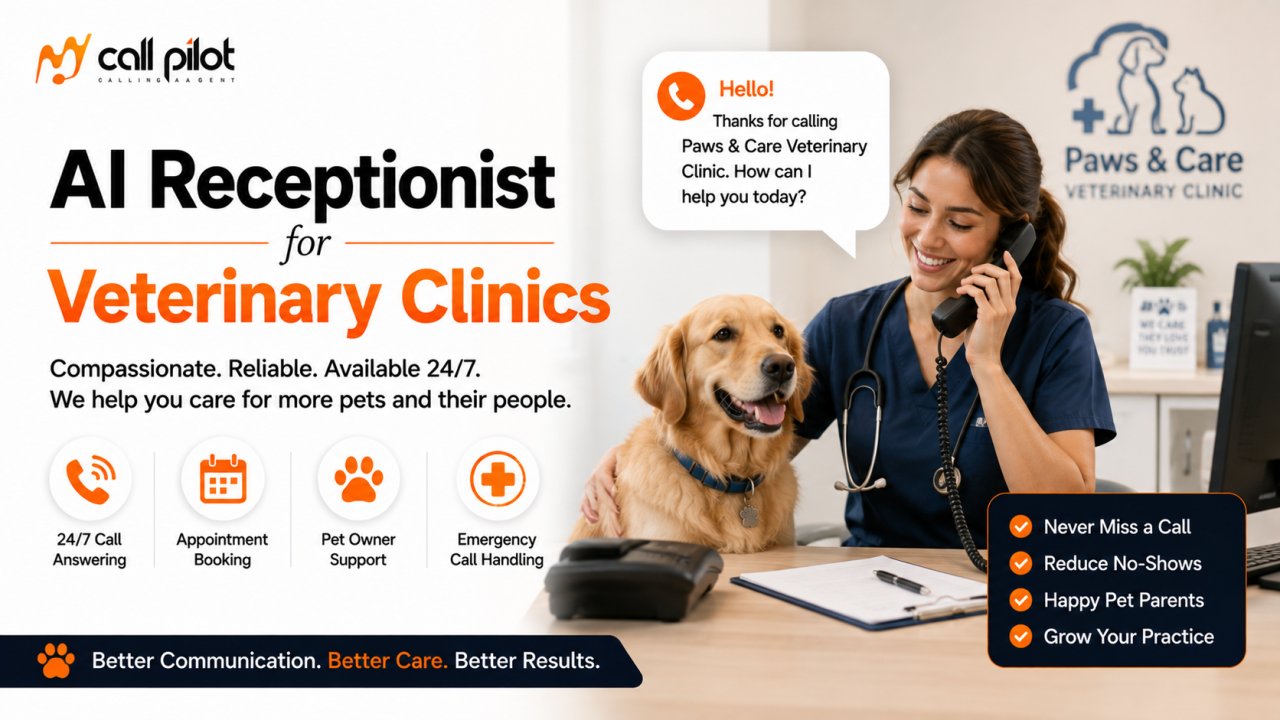
AI Receptionist for Veterinary Clinics helps veterinary teams manage incoming calls while keeping their attention where it matters most, with the patients and pet owners already in the clinic.
A veterinary practice can have a full waiting room, a veterinarian in an examination room, a technician assisting with a procedure, and a receptionist checking out another client while the phone keeps ringing.
That makes phone management different from ordinary office reception.
An AI receptionist can provide another layer of support by handling appropriate routine conversations, collecting caller information, supporting appointment workflows, and directing situations that require human attention to the right member of your team.
What Is an AI Receptionist for a Veterinary Clinic
An AI receptionist for a veterinary clinic is a conversational voice system designed to help manage inbound calls and routine administrative conversations for an animal care practice.
Depending on the provider and configuration, it may help with
• Answering incoming calls
• Handling common questions
• Capturing new client information
• Collecting pet information
• Managing appointment requests
• Supporting rescheduling requests
• Taking messages
• Routing calls
• Handling after hours inquiries
• Escalating urgent situations according to clinic instructions
• Creating call summaries
The important distinction is that an AI receptionist should support administrative communication rather than independently making veterinary diagnoses or treatment decisions.
Veterinary focused AI receptionist services commonly position urgent call routing and human escalation as important parts of the workflow.
Why Veterinary Clinics Need Better Phone Coverage
A veterinary clinic is an unusually active environment.
The phone can ring while someone is
• Checking in a nervous pet
• Holding an animal for examination
• Preparing a treatment room
• Assisting a veterinarian
• Processing a payment
• Speaking with another client
• Handling a new patient intake
• Coordinating an appointment
The problem is not that your staff do not care about callers.
The problem is that your team cannot physically be on the phone and provide hands on care at the same time.
A missed call can create several problems
A potential new client may call another clinic.
An existing client may leave a voicemail that requires additional follow up.
A routine appointment request may remain unresolved.
An urgent caller may not receive the immediate routing they expected.
Your front desk may spend valuable time returning calls that could have been handled during the original conversation.
That is why veterinary AI receptionist solutions increasingly focus on keeping routine calls answered while allowing staff to remain focused on patients.
What Can an AI Receptionist Do for a Veterinary Clinic
The exact capabilities depend on the provider and configuration.
The most useful applications are usually those involving repeatable administrative conversations.
Answer Common Questions
Pet owners frequently ask questions about
• Clinic hours
• Services
• Locations
• Appointment availability
• Directions
• New client procedures
• General pricing information
• Appointment preparation
• Routine administrative policies
When the information is properly configured, an AI receptionist can provide consistent answers without requiring a member of the front desk team to stop what they are doing.
Capture New Client Information
A new client call can contain valuable information.
Instead of simply receiving a voicemail, an AI receptionist may collect information such as
• Client name
• Phone number
• Pet name
• Pet type
• Reason for the visit
• Preferred appointment time
• Existing or new client status
The exact information collected should be determined by the clinic.
The goal is to make the eventual human follow up more useful.
Support Appointment Requests
Appointment calls are among the most obvious administrative workflows for conversational AI.
A caller may say that they want to schedule a wellness visit for their dog.
The AI can determine the basic purpose of the call and follow the clinic's configured scheduling workflow.
Depending on the technology being used, the system may support direct scheduling or simply collect the request for staff follow up.
Do not assume that every AI receptionist can directly access your practice management system.
Always verify this capability before purchasing.
Some veterinary AI providers currently advertise direct practice management system scheduling and appointment synchronization.
Handle Rescheduling and Cancellation Requests
Veterinary reception teams often spend significant time managing appointment changes.
A conversational receptionist can potentially help with appropriate requests such as
• Rescheduling a routine appointment
• Cancelling an appointment
• Confirming appointment details
• Collecting a preferred new time
• Recording a message for the front desk
Whether these actions can be completed automatically depends on the provider and the systems connected to it.
Support After Hours Calls
Veterinary care does not always fit neatly into office hours.
Pet owners may call in the evening, overnight, on weekends, or during holidays.
An AI receptionist can provide a consistent first point of contact during periods when your regular front desk is unavailable.
This does not mean the AI should attempt to replace emergency veterinary care.
Instead, an appropriate workflow should identify calls that require human attention and follow the clinic's approved escalation process.
Veterinary AI receptionist products commonly emphasize after hours answering and urgent call routing as core use cases.
Emergency Calls Require Special Care
This is one of the most important differences between a veterinary receptionist and a generic business receptionist.
A caller may describe an animal that has
• Been injured
• Ingested something potentially dangerous
• Collapsed
• Developed severe breathing problems
• Experienced a seizure
• Been involved in an accident
The AI should not attempt to diagnose the animal.
It should follow the clinic's approved instructions for identifying potentially urgent situations and routing the caller to the appropriate human or emergency resource.
The principle is simple
AI can support the communication workflow. Veterinary professionals remain responsible for clinical judgment.
That distinction should be part of your evaluation when selecting a veterinary AI receptionist.
AI Receptionist vs Traditional Veterinary Receptionist
AI and human receptionists can serve different roles.
| Area | AI Receptionist | Human Receptionist |
|---|---|---|
| Routine questions | Strong fit | Strong fit |
| Appointment requests | Possible depending on configuration | Strong fit |
| After hours coverage | Strong fit | Depends on staffing |
| Repetitive calls | Strong fit | Can consume staff time |
| Complex conversations | May require escalation | Stronger fit |
| Emotional situations | Human handoff may be appropriate | Strong fit |
| Clinical decisions | Should not make them | Requires qualified veterinary staff |
| Multiple simultaneous calls | Software dependent | Limited by staffing |
| Personal judgment | Limited | Strong |
| Human empathy | Conversational but limited | Strong |
The best implementation does not have to be AI versus humans.
It can be AI plus humans.
AI handles suitable routine conversations while your team handles situations where human judgment, empathy, or veterinary expertise matters.
AI Receptionist vs Voicemail
Voicemail asks the caller to leave information and wait.
An AI receptionist can potentially interact with the caller immediately.
With voicemail
The caller leaves a message.
Your staff reviews it later.
Someone calls the client back.
The conversation begins again.
With AI reception
The caller can explain the reason for calling.
The system can collect relevant details.
The request can be routed or documented.
Your team receives more context before following up.
For veterinary clinics, this difference can be particularly useful when the front desk is already occupied with clients and patients.
A Better Veterinary Call Workflow
A useful AI receptionist should not treat every caller the same.
A better workflow separates conversations according to their purpose.
New Client
Identify the caller as a potential new client.
Collect appropriate contact and pet information.
Determine the reason for the visit.
Support the next administrative step.
Existing Client
Identify the purpose of the call.
Handle appropriate routine requests.
Route matters requiring staff involvement.
Appointment Request
Determine the requested service.
Follow the clinic's scheduling rules.
Confirm the appropriate next step.
Routine Question
Provide approved information.
Avoid guessing when the answer is unavailable.
Urgent Concern
Follow the clinic's approved escalation workflow.
Do not provide unsupported clinical advice.
Human Request
Allow the caller to reach the appropriate member of the team when the configured workflow permits it.
This type of structured call handling is increasingly emphasized by veterinary AI providers. (WiscAI)
What Should Your AI Receptionist Know About Your Clinic
The quality of an AI receptionist depends heavily on the information and rules it receives.
Your clinic may need to provide information about
• Business hours
• Services
• Locations
• Appointment types
• Scheduling rules
• New client procedures
• Cancellation policies
• Payment policies
• Common questions
• Emergency instructions
• Human escalation rules
• Contact information
• Approved responses
The AI should not invent an answer simply because a caller asks a question.
If the information is unavailable, the system should use an appropriate fallback.
That principle is especially important in veterinary environments.
How AI Can Reduce Front Desk Pressure
Consider a typical clinic.
The receptionist is checking out a client.
The phone rings.
The caller wants to know whether the clinic is accepting new patients.
Another call arrives.
A client wants to move an appointment.
A technician needs assistance.
A veterinarian needs the receptionist to contact another client.
These interruptions add up.
An AI receptionist can take suitable routine conversations away from the front desk so staff can focus on work that genuinely requires their presence.
The goal is not to remove the human element from veterinary care.
The goal is to protect human attention for the moments when it matters most.
Which Veterinary Clinics Can Benefit
General Veterinary Practices
Routine appointments, new client inquiries, common questions, and scheduling requests can create significant phone workload.
Animal Hospitals
Larger call volumes can make consistent phone coverage more difficult.
Specialty Veterinary Practices
Specialized practices may receive detailed inquiries that require carefully designed routing and human follow up.
Multi Location Veterinary Groups
A consistent call workflow can help standardize administrative communication across locations.
Small Veterinary Practices
A smaller team may have fewer people available to answer phones while simultaneously caring for animals.
High Volume Clinics
When call volume increases, an automated first layer can help absorb appropriate routine requests.
When an AI Receptionist Is Not the Right Choice
AI should not be introduced simply because it is available.
You may need a stronger human role when conversations involve
• Complex medical concerns
• Highly emotional situations
• Sensitive client disputes
• Difficult billing conversations
• Unusual cases
• Requests requiring veterinary judgment
• Situations where a caller specifically needs a person
The right question is not
Can AI handle this call
The better question is
Should AI handle this call
That distinction can protect both the client experience and the clinic workflow.
How Much Does a Veterinary AI Receptionist Cost
Pricing varies significantly between providers.
Some services use monthly subscriptions.
Others use usage based pricing.
Some combine a monthly platform fee with call usage.
Some providers also charge separately for integrations or advanced functionality.
Instead of choosing the cheapest option, calculate what your clinic actually needs.
Consider
• Monthly call volume
• Average call duration
• After hours volume
• Appointment volume
• Required integrations
• Human transfer requirements
• Call recording
• Transcription
• Call summaries
• Setup fees
• Usage limits
• Additional usage charges
A lower monthly price may not be cheaper if important workflows require additional charges.
My Call Pilot pricing should only be added once the current commercial terms have been verified.
How to Calculate the Business Value
A veterinary clinic can build a simple internal model.
Start with
Monthly incoming calls
Then estimate
Calls currently missed
Then identify
Potential new client opportunities
Then estimate
Appointments generated
Then consider
Average value of an acquired client
You can also calculate staff time.
Estimate how much front desk time is spent on routine calls each month.
Then consider which portion could realistically be handled automatically.
The objective is not to promise a specific return.
The objective is to determine whether the phone workload is large enough to justify automation.
10 Questions to Ask Before Choosing an AI Receptionist
Can it understand veterinary terminology
A veterinary clinic has a different vocabulary from a general office.
Test the system using realistic conversations from your practice.
Can it follow our emergency instructions
Ask exactly how urgent calls are identified and escalated.
Can callers reach a person
Find out how human handoff works.
Can it schedule appointments
Determine whether it can actually schedule appointments or only collect requests.
Does it integrate with our practice management system
Never assume integration simply because another veterinary provider supports it.
Can we control its answers
You should be able to define the information the AI is permitted to provide.
What happens when it does not know something
A good fallback process is essential.
Can we review calls
Find out what call summaries, transcripts, logs, or other records are available.
What happens after hours
Understand exactly how urgent and routine calls are handled outside normal business hours.
Can we test real scenarios
Test new clients, existing clients, scheduling requests, difficult conversations, and urgent sounding calls before launch.
The Difference Between Answering Calls and Managing Conversations
An AI system that simply says hello and takes a message is very different from an AI receptionist that understands why a caller is contacting the clinic.
The more useful system thinks in terms of workflows.
A caller wants a vaccine appointment.
The system identifies the request.
A caller wants to change an appointment.
The system identifies the existing appointment workflow.
A caller has an urgent concern.
The system follows the clinic's approved escalation instructions.
A caller asks a routine question.
The system provides approved information.
That is the difference between automated call answering and AI assisted reception.
Why My Call Pilot
My Call Pilot can be considered as part of a veterinary clinic's broader phone automation strategy.
The most important question is not whether an AI receptionist sounds impressive.
The important question is whether it can fit the way your clinic actually works.
Before implementing any AI receptionist, map your existing calls.
Identify the questions your staff answer repeatedly.
Identify the appointment requests that consume the most time.
Identify after hours calls.
Identify situations that always need a human.
Then evaluate where automation makes sense.
Because current publicly indexed information does not provide enough verified detail about My Call Pilot's veterinary specific functionality, this page intentionally avoids unsupported claims about integrations, veterinary workflows, pricing, customer numbers, or performance.
Frequently Asked Questions
What is an AI receptionist for veterinary clinics
An AI receptionist is a conversational voice system that helps veterinary clinics manage inbound calls. Depending on its configuration, it may answer routine questions, collect client and pet information, support appointment workflows, take messages, and route calls that require human attention.
Can an AI receptionist schedule veterinary appointments
Some veterinary AI receptionist platforms can schedule appointments directly, while others collect appointment requests for staff follow up. The difference depends on the provider and its connection to the clinic's scheduling or practice management system.
Can an AI receptionist handle emergency calls
It can support the communication and routing process when configured correctly. It should not independently diagnose animals or make veterinary treatment decisions. Urgent situations should follow the clinic's approved escalation process.
Can an AI receptionist answer calls after hours
Yes. After hours coverage is one of the primary use cases promoted by veterinary AI receptionist providers. The exact hours and workflow depend on the provider.
Can an AI receptionist replace veterinary reception staff
It can automate selected administrative tasks, but it should not automatically be treated as a complete replacement for human reception staff. Human judgment and empathy remain important for complex conversations and situations requiring veterinary expertise.
Can AI answer questions about pet health
An AI receptionist should not independently diagnose a pet or provide unsupported treatment recommendations. Veterinary clinical questions should be handled according to the clinic's approved workflow and escalated to qualified veterinary professionals when appropriate.
Can an AI receptionist handle new clients
Yes, depending on configuration. A veterinary AI receptionist can potentially collect basic new client and pet information and support the next administrative step.
Can it handle multiple calls
AI systems can potentially handle concurrent conversations more easily than a single human receptionist, but actual capacity depends on the provider's architecture and plan. This should be tested before deployment.
Does an AI receptionist work with veterinary practice management software
Some veterinary AI providers advertise integrations with practice management systems. However, compatibility varies by provider and software platform, so a clinic should verify its exact system before purchasing.
Is an AI receptionist suitable for a small veterinary clinic
It can be useful when a small team struggles to answer phones while caring for patients. The business case depends on call volume, missed calls, staff workload, and the value of the administrative tasks being automated.
Keep Your Team Focused on Veterinary Care
Your reception team has more important work than repeatedly answering the same routine questions while patients are waiting.
An AI receptionist can provide another layer of phone coverage for appropriate conversations while allowing your team to focus on clients and animals who are already in front of them.
The best implementation does not remove people from the process.
It puts people where they are most valuable.