On this page (56)
- A Better Phone Workflow
- What Is an AI Telephone Answering Service?
- How Does AI Telephone Answering Work?
- 1. A Customer Calls Your Business
- 2. The AI Answers
- 3. The AI Listens to the Caller
- 4. The AI Determines What to Do Next
- 5. The Interaction Is Recorded for Follow-Up
- What Can an AI Telephone Answering Service Do?
- Answer Frequently Asked Questions
- Capture Leads
- Handle Appointment Requests
- Route Calls
- Take Messages
- Provide After-Hours Coverage
- AI Answering Service vs Voicemail
- AI Telephone Answering Service vs Human Answering Service
- The Strongest Model May Be Hybrid
- What Happens When the AI Does Not Know the Answer?
- Who Needs an AI Telephone Answering Service?
- Home Service Businesses
- Dental Practices
- Healthcare Practices
- Real Estate
- Legal Practices
- Property Management
- Automotive Businesses
- Professional Services
- What Does an AI Telephone Answering Service Cost?
- What Actually Determines Your Cost?
- How to Calculate the ROI of AI Phone Answering
- Step 1: Count Incoming Calls
- Step 2: Estimate Missed Calls
- Step 3: Separate Valuable Calls
- Step 4: Estimate Conversion
- Step 5: Calculate Customer Value
- Step 6: Compare Against the Service Cost
- 7 Questions to Ask Before Buying an AI Telephone Answering Service
- 1. Can I Test It With Real Calls?
- 2. What Happens When the AI Is Uncertain?
- 3. Can I Control What Information the AI Uses?
- 4. Can It Follow My Call-Routing Rules?
- 5. How Is Usage Billed?
- 6. What Happens to Call Information Afterward?
- 7. Can a Human Take Over?
- When Should You NOT Use AI Telephone Answering?
- AI Telephone Answering Should Not Mean Replacing Your Team
- What Makes a Good AI Telephone Answering Experience?
- AI Answering Service, AI Receptionist or AI Voice Agent?
- Why Businesses Are Moving Beyond Traditional Phone Menus
- The Real Value of AI Telephone Answering
- Start With the Calls You Most Want to Fix
- Frequently Asked Questions
- Can AI answer business calls 24/7?
- Can AI book appointments?
- Give Every Important Call Somewhere Useful to Go
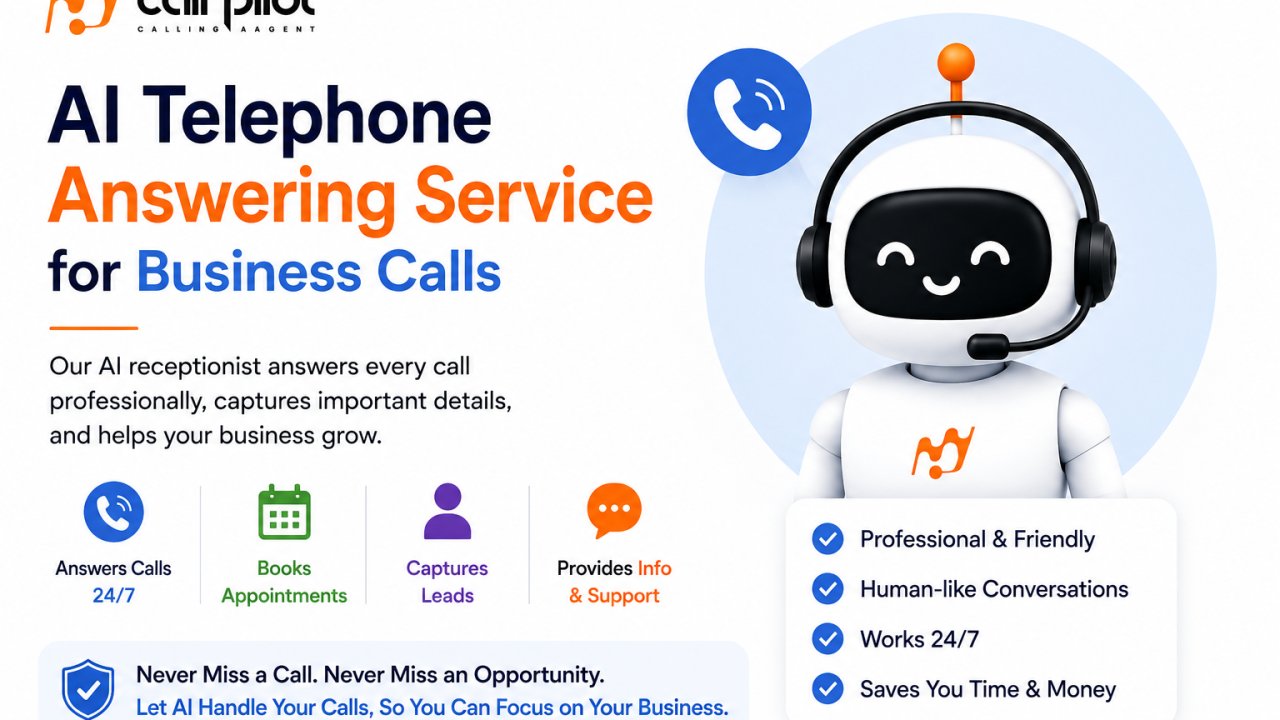
An AI telephone answering service helps your business handle incoming calls when your team is busy, unavailable or closed.
Instead of sending callers straight to voicemail, an AI-powered phone answering system can interact with them in natural language, understand why they are calling, provide approved information, collect details and route the conversation according to your business rules.
For businesses that depend on phone calls for leads, appointments, questions, bookings or customer support, the real value is not simply answering the phone. It is doing something useful with the call.
Give your customers a way to reach your business without requiring a member of your team to pick up every call. An AI telephone answering service can serve as the first layer of your phone operation, handling routine conversations while giving your team a structured way to deal with calls that require human attention.
A Better Phone Workflow
Incoming call → AI answers → understands the request → provides help or captures information → routes or escalates → your team follows up when necessary.
That is the difference between simply answering calls and actually handling them.
What Is an AI Telephone Answering Service?
An AI telephone answering service is a software-based voice system that answers business phone calls and interacts with callers using conversational artificial intelligence.
Unlike a traditional voicemail system, the caller can speak naturally instead of leaving a message after a tone. Unlike a basic IVR, the conversation does not necessarily depend on the caller choosing from a rigid sequence of menu options.
Depending on how the system is configured, an AI answering service can help with tasks such as:
- Answering common business questions
- Collecting caller information
- Understanding the reason for a call
- Capturing new leads
- Taking messages
- Handling appointment requests
- Routing calls
- Escalating calls to a person
- Providing business information
- Supporting after-hours coverage
- Creating a structured record of the interaction
The important word is configured. A good AI answering system should operate within clearly defined business information, rules and permissions and escalation paths rather than improvising answers it cannot verify.
How Does AI Telephone Answering Work?
1. A Customer Calls Your Business
The customer uses your normal business phone number or the number connected to your phone setup. The call is directed to the AI answering system according to the configuration you choose.
2. The AI Answers
Instead of reaching voicemail, the caller receives an immediate conversational response. The greeting can be designed around your business, the purpose of the call and the type of experience you want customers to receive.
3. The AI Listens to the Caller
The caller explains what they need in their own words. For example: "I'd like to book an appointment," or "I'm calling about a quote," or "I need to speak with someone about an existing order."
The system's job is to understand the intent rather than forcing the customer to navigate a long menu.
4. The AI Determines What to Do Next
The next step depends on the call. A routine question may receive an answer. A lead may be qualified. An appointment request may move into a scheduling workflow. A call requiring a person may be transferred or escalated. A caller who simply wants someone to call them back may have their information captured.
5. The Interaction Is Recorded for Follow-Up
Depending on the system configuration, the business may receive information such as the caller's details, reason for calling, conversation record or follow-up requirements. This turns an unanswered call into an actionable business event.
What Can an AI Telephone Answering Service Do?
The capabilities vary between providers, so buyers should evaluate the actual workflows rather than choosing a service based on the phrase "AI receptionist" alone.
Answer Frequently Asked Questions
An AI phone agent can be configured around information such as business hours, services, locations, general policies, appointment information, basic customer questions, contact information and service availability. The quality of these answers depends heavily on the information provided to the system.
Capture Leads
Instead of simply taking a name and number, an AI answering workflow can be designed to collect the information your business needs to decide what happens next.
For example, a home-service business might need the customer name, service required, property location, urgency, preferred appointment time and additional job details.
A professional service business might need the name, company, reason for inquiry, type of service required and preferred callback time.
The exact intake process should match the business.
Handle Appointment Requests
Appointment-related calls are one of the clearest applications for conversational phone automation. A properly configured system can collect appointment requirements and, where the necessary scheduling capability is available, help move the caller toward an available appointment.
The important consideration is not whether an AI can say "I can book your appointment." The important consideration is whether it can actually complete the required workflow reliably.
Route Calls
Not every call should be handled by AI. Some callers need a particular employee, department, technician, salesperson or manager. An effective phone answering system can therefore be designed around routing rules, for example a sales inquiry going to the sales team, an existing customer going to support, an urgent request going to a designated contact, a general question being handled by the AI and an unknown or complex request being escalated to a human.
Take Messages
When a human is required but unavailable, the AI can collect structured information instead of forcing the caller to leave an unstructured voicemail. That can make the eventual callback more useful.
Provide After-Hours Coverage
A business does not stop receiving customer questions simply because its office closes. After-hours answering can help businesses establish a consistent first point of contact outside normal operating hours. For some businesses, this is particularly important when calls involve urgent services, appointment requests, new leads or customers in different time zones.
AI Answering Service vs Voicemail
| Capability | Voicemail | AI Telephone Answering |
|---|---|---|
| Answers caller | Yes | Yes |
| Natural conversation | No | Yes |
| Answers routine questions | No | Potentially |
| Captures structured information | Limited | Yes, when configured |
| Qualifies a lead | No | Potentially |
| Routes calls | Limited | Yes, when configured |
| Appointment workflow | No | Potentially |
| After-hours coverage | Yes | Yes |
| Human escalation | Caller leaves message | Can be built into the workflow |
Voicemail still has a place. It is simple, inexpensive and familiar. But it puts most of the responsibility on the caller. An AI answering service can take more responsibility for the first stage of the interaction.
AI Telephone Answering Service vs Human Answering Service
AI is not automatically better than a human answering service. The better question is which type of call should be handled by which type of resource.
| AI Answering Service | Human Answering Service | |
|---|---|---|
| Routine questions | Strong fit | Strong fit |
| Repetitive calls | Strong fit | Possible |
| 24/7 coverage | Strong fit | Available with staffing |
| Simultaneous call volume | Strong fit | Limited by staffing |
| Structured lead intake | Strong fit | Strong fit |
| Complex judgment | Limited | Strong |
| Sensitive conversations | May require escalation | Stronger fit |
| Unusual requests | May require escalation | Strong |
| Consistent scripted workflows | Strong | Strong |
| Human empathy | Limited | Strong |
| Scalability during call spikes | Strong | Staffing-dependent |
Current market comparisons consistently frame the choice this way: AI tends to be strongest for routine, repeatable, high-volume interactions while humans retain an advantage when judgment, empathy, negotiation or unusual circumstances are central to the conversation.
The Strongest Model May Be Hybrid
You do not necessarily need to choose between AI and people. A practical model is AI handling the predictable calls while humans handle the calls that need human judgment. That allows automation to absorb repetitive phone work without pretending every conversation should be automated.
What Happens When the AI Does Not Know the Answer?
This is one of the most important questions to ask before buying an AI telephone answering service. A responsible system should have a defined fallback. That may mean the AI explains that it cannot answer the question, collects the caller's information, routes the call to an appropriate person, creates a follow-up requirement and avoids inventing an answer.
The last point is critical. A confident wrong answer is worse than a transparent escalation.
When evaluating providers, ask what the system does when the caller asks something outside its knowledge. If the answer is unclear, keep asking.
Who Needs an AI Telephone Answering Service?
AI phone answering is particularly useful when phone calls are important to revenue but employees cannot consistently answer them.
Home Service Businesses
Plumbers, HVAC companies, electricians, cleaners, landscapers, roofers and other contractors are often away from the office while customers are calling. An AI answering workflow can provide an initial point of contact while the team is on a job.
Dental Practices
Dental offices receive recurring calls about appointments, availability, office information, cancellations and other routine matters. AI can potentially reduce the amount of repetitive phone work reaching the front desk.
Healthcare Practices
Healthcare requires additional care. AI should not be treated as a substitute for professional clinical judgment. Sensitive or clinical situations may require appropriate human handling, escalation or specialized workflows. The opportunity is primarily around administrative communication where automation is appropriate.
Real Estate
Real estate professionals can receive inquiries while showing properties, driving or meeting clients. An AI answering service can provide an initial response and capture useful information for follow-up.
Legal Practices
Law firms often need structured intake rather than a simple name and phone number. An answering workflow can potentially collect preliminary information and route inquiries appropriately. Sensitive legal matters should be handled according to the firm's own policies and escalation rules.
Property Management
Property managers deal with recurring tenant, prospect, maintenance and property-related calls. An AI system can potentially separate routine requests from calls requiring a human.
Automotive Businesses
Repair shops and dealerships can receive calls about appointments, service questions, vehicle inquiries and follow-up. Automating routine requests can help staff remain focused on customers already at the business.
Professional Services
Consultancies, agencies, financial services, B2B providers and other professional businesses can use AI phone answering to create a more consistent first point of contact. The best applications are generally the calls that follow repeatable patterns.
What Does an AI Telephone Answering Service Cost?
There is no single market price. AI phone answering services use several pricing models including monthly subscriptions, included call minutes, per-minute pricing, per-call pricing, usage tiers, per-agent pricing, add-on pricing and custom enterprise pricing.
Current pricing illustrates how widely the market varies, with basic AI answering plans starting around $15 to $50 per month depending on included minutes and features, while more advanced AI receptionist plans can run higher. Traditional human answering services typically cost considerably more, often ranging from a few hundred dollars a month for lower call volumes to well over a thousand dollars a month for higher volumes.
These figures should be treated as general market examples and not as a universal rate.
What Actually Determines Your Cost?
Before comparing prices, calculate monthly calls multiplied by average call duration multiplied by required coverage multiplied by required workflows multiplied by integration or setup requirements. Then compare the resulting cost with the business value of the calls being handled.
The cheapest service is not necessarily the least expensive option. If a low-cost system cannot handle your important calls, you may simply be paying for another layer of voicemail.
How to Calculate the ROI of AI Phone Answering
Start with your own calls.
Step 1: Count Incoming Calls
How many calls does your business receive each month?
Step 2: Estimate Missed Calls
How many arrive when nobody can answer?
Step 3: Separate Valuable Calls
Not every missed call has equal value. Identify new leads, existing customers, appointment requests, urgent requests, sales inquiries and general questions.
Step 4: Estimate Conversion
Of the calls that represent genuine opportunities, how many normally become customers?
Step 5: Calculate Customer Value
Estimate the average value of a new customer.
Step 6: Compare Against the Service Cost
The basic model is missed opportunities multiplied by conversion rate multiplied by average customer value equals potential opportunity value. Then compare that with the cost of phone automation.
This is not a revenue guarantee. It is a framework for deciding whether improving call coverage deserves a place in your operating budget.
7 Questions to Ask Before Buying an AI Telephone Answering Service
1. Can I Test It With Real Calls?
A polished demo is not enough. Test realistic situations such as interruptions, accents, unclear questions, unexpected requests, pricing questions, appointment changes and requests for a human.
2. What Happens When the AI Is Uncertain?
You need to understand the escalation process before going live.
3. Can I Control What Information the AI Uses?
Ask how business information is supplied, updated, reviewed and removed.
4. Can It Follow My Call-Routing Rules?
Your phone system should reflect your business structure rather than forcing your business into a generic workflow.
5. How Is Usage Billed?
Ask specifically about included minutes, overage charges, call transfers, phone numbers, setup, additional agents, integrations and taxes or other charges.
6. What Happens to Call Information Afterward?
Ask about transcripts, summaries, recordings, data retention, access and integrations.
7. Can a Human Take Over?
For many businesses, this should be a basic requirement rather than an optional extra.
When Should You NOT Use AI Telephone Answering?
AI is not the right answer for every phone call. You may want a human-first approach when conversations routinely involve highly sensitive personal situations, complex negotiations, emotional support, high-stakes professional judgment, unpredictable conversations, situations requiring specialist expertise and customers who strongly expect a human interaction.
You may also want to avoid automating a process until you understand it. Automating a bad call flow simply makes the bad experience happen faster. Start with the calls that are repetitive, well understood and easy to define. Then expand.
AI Telephone Answering Should Not Mean Replacing Your Team
The most useful way to think about AI phone answering is as a front-line communication layer. Your team still handles the work that requires judgment, expertise, empathy, negotiation, relationship building, physical action and complex problem solving.
The AI can take responsibility for appropriate first-line interactions so your employees can spend more time on the conversations that genuinely require them. That distinction makes implementation easier to manage.
What Makes a Good AI Telephone Answering Experience?
A good system should not simply sound human. It should be useful. Look for these characteristics:
- Clear — the caller understands what is happening
- Relevant — the system responds to what the caller actually asked
- Controlled — the AI operates within defined business information and rules
- Action-oriented — the conversation leads somewhere useful
- Escalation-ready — a human can become involved when necessary
- Consistent — the experience does not depend on which employee happens to answer
- Measurable — the business can understand what happened to its calls
The goal is not to create the most impressive AI demo. The goal is to create a better telephone operation.
AI Answering Service, AI Receptionist or AI Voice Agent?
These terms overlap, but they often emphasize different things.
| Term | Usually Emphasizes |
|---|---|
| AI telephone answering service | Answering incoming business calls |
| AI answering service | Automated phone coverage |
| AI receptionist | Front-desk responsibilities |
| AI voice agent | Conversational voice automation |
| Virtual receptionist | Remote receptionist function |
| Conversational AI | Natural-language interaction |
The terminology matters less than the actual workflow. When evaluating a provider, ask what the system can actually do after it answers the call. That question is more useful than comparing product labels.
Why Businesses Are Moving Beyond Traditional Phone Menus
Traditional IVR systems can be useful when the caller needs a small number of predictable options. But a rigid menu can create friction when the caller's request does not fit neatly into those choices.
A conversational system changes the interaction. Instead of pressing 1 for sales, 2 for support or 3 for billing, the caller can potentially explain the reason for the call directly.
That does not mean IVR is obsolete. It means businesses now have another option for handling calls where natural language is more convenient than menu navigation.
The Real Value of AI Telephone Answering
The value is not simply never missing a call. The more useful question is what happens to the call that would otherwise have been missed.
If the answer is that a useful question gets answered, a lead gets captured, an appointment moves forward, a customer reaches the right team, an urgent request gets escalated and a callback becomes actionable, then the phone system is doing more than answering. It is helping operate the business.
Start With the Calls You Most Want to Fix
You do not need to automate your entire phone operation on day one. Start with one category, such as after-hours calls. Then move to frequently asked questions, then lead capture, then appointment requests and then call routing.
Once each workflow is reliable, you can decide whether additional automation makes sense. The objective is not maximum automation. It is better call handling.
Frequently Asked Questions
What is an AI telephone answering service?
An AI telephone answering service is software that answers business phone calls and interacts with callers using conversational voice AI. Depending on its configuration, it can answer routine questions, capture information, qualify inquiries, route calls, take messages, support appointment workflows and escalate conversations to humans.
Is an AI answering service the same as an AI receptionist?
The terms overlap. An AI answering service generally emphasizes answering incoming calls, while an AI receptionist usually describes a broader front-desk role that may include routing, scheduling, FAQs and intake. The actual capabilities depend on the provider and configuration.
Can AI answer business calls 24/7?
Many AI answering services are designed to operate continuously, including after business hours. However, buyers should verify the provider's actual coverage, usage limits, escalation process and phone-system configuration rather than assuming every service offers identical 24/7 functionality.
Can an AI telephone answering service transfer callers to a human?
Many systems support human escalation or call transfer, but the exact routing options vary. Before purchasing, confirm how transfers work, which numbers can receive calls, what happens when nobody answers and whether transfers incur additional charges.
Can AI book appointments?
Some AI answering systems support appointment scheduling. Whether this is possible depends on the provider, calendar connection, scheduling rules and configuration. Ask the provider to demonstrate the complete booking workflow rather than simply showing a scripted demo.
Is AI telephone answering cheaper than a human answering service?
AI services can be less expensive than human answering services, particularly for repetitive calls and continuous coverage, but pricing varies considerably. Compare the total cost at your actual call volume.
Will callers know they are speaking with AI?
That depends on the provider, configuration, voice and conversation. Businesses should decide how transparent they want the experience to be and ensure the system communicates appropriately rather than attempting to mislead callers.
What happens if the AI cannot answer a question?
A properly designed workflow should have a fallback. Depending on the business, that could involve transferring the caller, taking a message, collecting contact details or creating a follow-up task. The system should not invent information simply to keep the conversation going.
Can an AI answering service replace a receptionist?
It can automate some responsibilities traditionally handled by receptionists, but that does not mean it should replace every human front-desk function. AI is generally better suited to predictable, repeatable workflows, while humans remain important for judgment, complex conversations, sensitive situations and relationship-driven interactions.
What businesses benefit most from AI phone answering?
Businesses with meaningful inbound call volume and repetitive phone workflows are strong candidates, including home services, contractors, dental practices, real estate, property management, automotive businesses and professional services.
What should I test before choosing an AI answering service?
Test real scenarios rather than relying on a polished demonstration. Try common questions, interruptions, ambiguous requests, lead qualification, appointment requests, requests for a human and situations where the AI does not have enough information to answer confidently.
Give Every Important Call Somewhere Useful to Go
Your customers should not have to guess whether someone will answer. And your team should not have to stop what they are doing every time the phone rings.
An AI telephone answering service can create another layer between the incoming call and your employees, answering appropriate calls, handling defined workflows, capturing useful information and escalating when a person is needed.
The right setup is not about replacing every human interaction. It is about making sure the right calls reach the right place.